
![Legal Marketing in the Post COVID-19 Work Environment with Jaffe PR [PODCAST]](https://i0.wp.com/nationallawforum.com/wp-content/uploads/2021/09/Headphones_Legal-News-Reach-1-1.jpg?resize=825%2C510&ssl=1)
In this inaugural episode of the Legal News Reach podcast, Rachel and Jessica discuss marketing in the post-COVID work environment with Melanie Trudeau, Director of New Business & Digital Strategies with Jaffe PR.

COVID-19: President Biden Targets Private Employers and Federal Employees and Contractors in His “Path Out of the Pandemic”
On 9 September 2021, President Biden announced his comprehensive national strategy for addressing the COVID-19 pandemic including multiple directives and actions targeted at federal, private-sector, and healthcare employers. The strategy includes regulatory action from the Occupational Safety and Health Administration (OSHA) and the Centers for Medicare & Medicaid Services (CMS) in addition to two Executive Orders, all of which include sweeping vaccination and COVID-19 safety mandates. Though the six-pronged action plan includes measures focused on vaccination efforts, protecting already vaccinated individuals, keeping schools safely open, increasing access to testing, safeguarding economic recovery, and improving care for those affected by COVID-19, this alert will address the specific directives affecting employers.
OSHA EMERGENCY TEMPORARY STANDARD FOR LARGE PRIVATE-SECTOR EMPLOYERS
As outlined in the President’s six-pronged strategy, the White House has directed OSHA to issue an emergency temporary standard (ETS) that would require private employers with 100 or more employees to either mandate the COVID-19 vaccine for its workforce or require weekly COVID-19 testing before reporting to a worksite. Though limited details were provided, this ETS would apply to approximately 80 million private-sector workers in the United States. As part of the ETS, covered employers would also be required to provide paid time off for time spent obtaining a COVID-19 vaccine as well as for recovery from post-vaccination symptoms. The ETS is anticipated to be published in the coming weeks.
As background, OSHA is authorized to issue emergency temporary standards under limited conditions, specifically when it has determined that workers may be in grave danger and a new standard is necessary for their protection in the workplace. After initial publication in the Federal Register, the temporary standard follows the usual rulemaking procedure for a permanent standard, though the timeline for a final ruling is within six months of publication. Finally, an ETS may be challenged in the appropriate U.S. Court of Appeals.1
OSHA most recently issued an ETS on 10 June 2021 that was limited to the healthcare industry. Prior to that, OSHA had not issued an emergency temporary standard since November 1983, and that one (related to asbestos) was invalidated by the U.S. Court of Appeals for the Fifth Circuit about four months later. It is reasonable to expect that a new ETS may also face legal challenges, not only in the regular course, but also due to a potential clash with state legislation and executive actions prohibiting certain requirements related to COVID-19 vaccinations.
EXECUTIVE ORDERS DIRECTED AT FEDERAL EXECUTIVE EMPLOYEES AND FEDERAL CONTRACTORS
The President’s plan also includes an Executive Order mandating the vaccine for federal executive branch employees, with exceptions only as permitted by law. Although few details have been provided, the Executive Order directs the Safer Federal Workforce Task Force (Task Force) to issue guidance within seven days as to the specific implementation protocols for affected agencies.
A separate Executive Order requires agencies to include a clause in certain federal contracts providing that contractors must comply with all workplace safety guidelines issued by the Task Force, with the specific protocols and any exceptions to be published by 24 September 2021. By 8 October 2021, the Federal Acquisition Regulatory Council, which is responsible for promulgating the Federal Acquisition Regulation (FAR), is required to (1) begin drafting the FAR clause required by the Executive Order and (2) recommend that agencies use their authority under FAR Subpart 1.4 to deviate from the FAR to include the Executive Order’s requirements in specific types of contracts. Agencies also are required to take steps to ensure that the Executive Order’s requirements are included in contracts and contract-like instruments that are not subject to the FAR, such as other transaction agreements, entered into on or after 15 October 2021. The clause will be included in contracts or contract-like instruments for services, construction, leases, and concessions. It also will be included in contracts and contract-like instruments subject to the Service Contract Act or entered into with the Federal Government in connection with Federal property or lands and related to offering services for Federal employees, their dependents, or the general public. The Executive Order specifically excludes certain types of federal agreements from compliance with the new requirement. Most notably, the Executive Order excludes federal grants, contracts below the simplified acquisition threshold (currently $250,000), and subcontracts solely for the provision of products.
EXPANDED CMS REGULATIONS FOR HEALTHCARE FACILITIES
The President’s plan also expands on the 18 August 2021 CMS emergency regulation requiring vaccination for nursing facility staff, by requiring employees of all healthcare facilities that receive funds from Medicare and Medicaid to be fully vaccinated. The new CMS directive will expand the vaccination mandate to hospitals, home care facilities and dialysis centers in the United States and will apply to nursing home staff as well as staff in hospitals and other CMS-regulated settings, including clinical staff, individuals providing services under arrangements, volunteers, and staff who are not involved in direct patient, resident, or client care. Although some states have begun to adopt vaccination mandates for the healthcare industry, the CMS directive will develop a uniform standard across all covered entities. CMS is in the process of developing an Interim Final Rule with Comment Period that will be issued in October.
PRACTICAL CONSIDERATIONS FOR EMPLOYERS
Given the broad scope of the President’s plan and the pending ETS, employers, including federal contractors, should evaluate coverage under any of the aforementioned mandates and work with counsel to develop and implement a compliance program that complies with federal, state, and local laws. Depending upon the scope of the ETS, there may be additional issues under the National Labor Relations Act and the Fair Labor Standards Act, as well as state wage and hour laws. Unionized employers should be cognizant of how these directives may impact obligations under collective bargaining agreements or whether a vaccine program would be a mandatory subject of bargaining. Finally, employers must address employee and applicant requests for a reasonable accommodation under both the Americans with Disabilities Act and Title VII of the Civil Rights Act if requiring vaccination as a condition of employment.
1 29 U.S. Code §655 (“Any person who may be adversely affected by a standard issued under this section may at any time prior to the sixtieth day after such standard is promulgated file a petition challenging the validity of such standard with the United States court of appeals for the circuit wherein such person resides or has his principal place of business, for a judicial review of such standard. A copy of the petition shall be forthwith transmitted by the clerk of the court to the Secretary.”).
Copyright 2021 K & L Gates
Article By Amy Conant Hoang, David Y. Yang, Erica L. Bakies, Rio J. Gonzalez and Erinn L. Rigney of K&L Gates
For more articles on mandatory COVID-19 vaccines, visit the NLR Coronavirus News section.

New York HERO Act Alert: COVID-19 Designated as Highly Contagious Communicable Disease
On September 6, 2021, New York State Commissioner of Health Howard A. Zucker designated COVID-19 as “a highly contagious communicable disease that presents a serious risk of harm to the public health in New York State.” As a result of the commissioner’s designation, employers are required to activate their airborne infectious disease exposure prevention plans in accordance with the New York Health and Essential Rights Act (NY HERO Act).
As we previously reported, on July 6, 2021, the New York State Department of Labor (NYS DOL), in consultation with the New York State Department of Health, published the Airborne Infectious Disease Exposure Prevention Standard and Model Airborne Infectious Disease Exposure Prevention Plan. Although the NYS DOL initially published the standard and model plan only in English, the NYS DOL has since furnished the standard and the model plan in Spanish. The industry-specific templates, for “Agriculture,” “Construction,” “Delivery Services,” “Domestic Workers,” “Emergency Response,” “Food Services,” “Manufacturing and Industry,” “Personal Services,” “Private Education,” “Private Transportation,” and “Retail,” are available only in English.
When the standard and the model plan were published, COVID-19 had not received the commissioner’s designation as a highly contagious communicable disease presenting a serious risk of harm to the public health. Now, because of the September 6, 2021, designation, employers with employees in New York may wish to ensure that they are complying with the applicable provisions of the NY HERO Act. Specifically, if not already completed, each employer shall:
-
Immediately review . . . and update the plan, if necessary, to ensure that it incorporates current information, guidance, and mandatory requirements, issued by federal, state, or local governments related to [COVID-19];
-
Finalize and promptly activate the . . . plan;
-
Provide the verbal review [in accordance with the plan];
-
Provide each employee with a copy of the . . . plan in English or in [Spanish, if identified as the employee’s primary language];
-
Post a copy of the plan in a visible and prominent location at the worksite (except when the worksite is a vehicle);
-
Ensure that a copy of the . . . plan is accessible to employees during all work shifts.
Per the act, if an employer has a handbook, the plan must be included in the handbook.
Because Commissioner Zucker’s designation requires activation of the plans, employers may also want to consider that the model plan and industry-specific templates provide that when a plan is activated, training “which will cover all elements” of the plan must be provided. Per the model plan and industry-specific templates, the topics to be covered during training include the following:
-
The infectious agent and the disease(s) it can cause;
-
The signs and symptoms of the disease;
-
How the disease can be spread;
-
An explanation of [the] … [p]lan;
-
The activities and locations at [the employer’s] worksite that may involve exposure to the infectious agent;
-
The use and limitations of exposure controls[;]
-
A review of the standard, including employee rights provided under [the NY HERO Act].
The model plan and industry-specific templates also provide that the training will be furnished “at no cost to employees and take place during working hours,” or, if training cannot take place during normal work hours, that “employees will be compensated for the training time (with pay or time off).” In addition, the training is required to be “[a]ppropriate in content and vocabulary to [the] educational level, literacy, and preferred language” of each employee and “[v]erbally provided in person or through telephonic, electronic, or other means.”
The commissioner’s designation will remain in effect until September 30, 2021, at which point the commissioner will “determine whether to continue [the] designation.” Accordingly, employers may wish to continue to monitor guidance and information from the New York State Department of Health and the NYS DOL to determine additional or continuing obligations, if any.
© 2021, Ogletree, Deakins, Nash, Smoak & Stewart, P.C., All Rights Reserved.
For more articles on the NY HERO Act, visit the NLR Labor & Employment section.

A Simple Solution for Your Stuff: The Use of a Separate Writing for the Disposition of Tangible Personal Property
If you have a Will (and you should!), part of your Will gives away your tangible personal property, your stuff, as George Carlin would call it. Tangible personal property is all your household goods, furniture, furnishings, clothing, boats, automobiles, books, art, jewelry, club memberships and articles of personal adornment or household use. It is anything that is not real property, like your house, and not intangible property, like stocks or bank accounts. It is your grandmother’s silver tea service, your favorite set of golf clubs, and all that other stuff you love, and which may become the stuff of heated family discussions after you are gone. Who gets it? You can and should decide now. After all, it’s your stuff.
In your Will, you can give all your tangible personal property to one person or another, or you can give particular items to particular people. The problem is that if you change your mind about an item or a person after you sign your Will, you have to either completely re-do your Will or prepare a special amendment to your Will called a “codicil.” Both alternatives require not only the input of an attorney but also the presence of two witnesses and a notary public.
Fortunately, several states, such as Florida and South Carolina, offer a simple solution for your stuff. According to Florida Statute 732.515 and South Carolina Probate Code Section 62-2-512, you may dispose of any item of tangible personal property by a memo prepared by you, separate from your Will. The memo can be done without witnesses or notarization. And you can change it as often as you like, without changing your Will.
For the memo to be valid, your Will must refer to it and may provide that the most recent version of the memo supersedes any prior version. The memo must describe each item and the identity of its recipient with reasonable certainty and you must sign and date the memo or, alternatively, in SC, the memo must be in your handwriting. If you revise the memo or prepare a new one, it is important to sign and date it (or, in SC, make sure the revised memo is in your handwriting).
There are limitations on the types of tangible personal property you can list in the memo. It cannot be used to dispose of property used in your trade or business, cash money or books, paper, or documents whose chief value is evidence of intangible property rights, such as bank books, stock certificates, promissory notes, insurance policies, and items like that. In Florida, the memo should also not be used to give away a coin collection, because the law governing that is not yet settled.
Finally, you should treat the memo as though it is your Will. It should be kept with your Will because the assets listed in the memo will be administered as though actually set forth in your Will. If your Will is in your attorney’s vault, send the original memo to your attorney for safekeeping in the attorney’s vault and keep a copy of the memo with the copy of your Will.
For those who have a revocable trust, there is currently no statute in Florida or South Carolina concerning separate writings for tangible personal property applicable to revocable trusts. So, a reference to a memo in your trust may not work. A better move is to have such a reference in your Will.
The disposition of tangible personal property is often an afterthought. It shouldn’t be. A close, loving family can be torn apart by arguments over family heirlooms, even those of little monetary value. Talk to your loved ones now about which items of yours they want, and then prepare a separate writing for the disposition of your tangible personal property. Do a memo for your stuff.
Copyright ©2021 Nelson Mullins Riley & Scarborough LLP
Article By Cynthia Bock and Maurice D. Holloway of Nelson Mullins

CDC Eviction Moratorium: The Final Word
Yesterday, the United States Supreme Court nullified a nationwide residential eviction moratorium that has been in place for nearly a year. Alabama Association of Realtors v. U.S. Department of Health and Human Services, 594 U.S. —- (2021)
Last September, the Centers for Disease Control and Prevention (CDC) ordered this nationwide moratorium, citing authority it said granted sweeping powers to limit the spread of the SARS CoV‑2 virus. 85 Fed. Reg. 55,292. Specifically, the CDC said it could enact the order as a measure it deemed “necessary” to achieve its goal of limiting the spread of the novel coronavirus. See 42 U.S.C. § 264(a) (referred to as § 361(a)). Challengers argued that the order exceeded the scope of authority Congress had vested in the CDC under § 361(a). Nonetheless, this order remained effective until its July 31, 2021 expiration date. Three days after it lapsed, the CDC replaced it with a new one. 86 Fed. Reg. 43,244.
On August 26, 2021, the Supreme Court agreed with the parties challenging the CDC’s orders. Saying that it “strains credibility to believe that this statute grants the CDC the sweeping authority it asserts,” the court found that the CDC’s broad interpretation of its mandate could permit dramatic administrative overreach. To illustrate this, the court posed several hypotheticals: “Could the CDC, for example, mandate free grocery delivery to the homes of the sick or vulnerable? Require manufacturers to provide free computers to enable people to work from home? Order telecommunications companies to provide free high-speed Internet service to facilitate remote work?” To the contrary, the court found that § 361(a)’s second sentence was instructive as to the types of measures the CDC could implement, which focused strictly on “measures [that] directly relate to preventing the interstate spread of disease by identifying, isolating, and destroying the disease itself.” Here, the CDC’s remedy was too attenuated.
“It is up to Congress, not the CDC, to decide whether the public interest merits further action here.” Indeed, “Congress was on notice that a further extension would almost surely require new legislation, yet it failed to act in the several weeks leading up to the moratorium’s expiration.” Even if the CDC was faced with legislative inaction and motivated by “desirable ends,” “our system does not permit agencies to act unlawfully[.]” See also Youngstown Sheet & Tube Co. v. Sawyer, 343 U.S. 579, 582, 585-586 (1952).
Given all of this, the court determined that the parties challenging the moratorium “not only have a substantial likelihood of success on the merits—it is difficult to imagine them losing.” Accordingly, the court vacated the stay on the District Court’s decision holding the CDC order invalid.
Critically, this decision is not a blanket nullification of any other moratoria that may be in effect (including state and local moratoria), nor does it affect any practical limitations on the exercise of remedies, such as the inability to hold a public sale necessary to foreclose in certain jurisdictions. It also leaves open the possibility of further congressional action.
© 2021 Miller, Canfield, Paddock and Stone PLC
For more on COVID-19 Evictions, visit the NLR Construction & Real Estate section.

Does It Matter if a Trust Is Revocable or Irrevocable? Yes, It Matters a Lot!
A recent decision issued by the Supreme Court of Alabama highlights the importance, for both creators and beneficiaries of trusts, of understanding whether a trust is Revocable or Irrevocable, and the consequences that flow from that distinction.
Revocable and Irrevocable Trusts
Any trust has three players: a Settlor, a Trustee, and a Beneficiary. The Settlor creates (or “settles”) the trust, and the Trustee manages the trust assets based on written instructions from the Settlor (typically in the form of a Trust Agreement) for the benefit of a Beneficiary. A trust can be created during the Settlor’s lifetime (a “Living Trust”), in which case the trust can be either revocable or irrevocable, or upon the Settlor’s death, usually under the provisions of a Will (a “Testamentary Trust”) which, because the Settlor is deceased, is always irrevocable.
An Irrevocable Trust generally cannot be revoked or modified, exactly as the name implies. However, in some states (including New Jersey and Alabama), either the Trustee or a Beneficiary (not the Settlor) of an Irrevocable Trust may bring an action in court to modify or terminate the trust, or an Irrevocable Trust can be modified or terminated upon consent of the Trustee and all Beneficiaries if the modification or termination is not inconsistent with a material purpose of the trust.
The Alabama Case
The Alabama case referenced above involved a Husband and Wife who in 2012 engaged in a common estate planning technique known as non-reciprocal SLATs, or Spousal Lifetime Access Trusts. Essentially, the Husband created a trust for the benefit of the Wife during her lifetime, and upon her death, the trust assets would pass to their three children; and the Wife created a trust for the benefit of the Husband during his lifetime, and upon his death, the trust assets would pass to the children.
The trusts were designed to utilize the couple’s Federal Estate Tax Exemptions before those Exemptions were to be substantially reduced beginning in 2013 (which, as it turns out, did not happen), while retaining access to the underlying trust assets through their interests as beneficiaries. However, the Wife died in 2017. Accordingly, the assets of the trust that the Husband created for her passed to the children, thereby ending his access to the assets of that trust.
The Husband brought an action in court to have the trust rescinded (in other words, revoked) and the assets returned to him, claiming that he did not understand that the trust assets would pass to his children if his Wife predeceased him. The court, relying on the testimony of his attorney, who stated that the trust worked exactly as designed and explained to his clients, held in favor of the children.
It Matters a Lot
The takeaway for Settlors of an Irrevocable Trust is that irrevocable means irrevocable; they cannot get back whatever money or property they transfer to the trust. The lesson for beneficiaries of those trusts is the same: if the Settlor has a change of heart after the trust is formed and funded, irrevocable means irrevocable.
This article was written by James J. Costello Jr.
For more articles regarding estate and trust law, please visit our Family, Estates and Trusts page.

Health Care Settings Subject to New COVID-19 Requirements Issued by New Jersey and OSHA
Health care settings continue to be at the center of testing and treatment for COVID-19 and are the focus of new safety requirements implemented to minimize risks of transmission. Last month, Governor Murphy issued an Executive Order related to vaccination management, COVID-19 testing, and data collection, which mandates “covered health care and high-risk congregate settings” to establish a policy requiring “covered workers” to either submit proof of full vaccination or to submit to weekly COVD-19 testing. This requirement goes into effect on September 7, 2021.
In addition, the Occupational Health and Safety Administration (OSHA) has implemented an emergency temporary standard (ETS) applicable to certain health care settings, which includes extensive safety and health measures. The ETS provides for certain exceptions for coverage, and while the precise definitions are complicated and must be consulted, the focus appears to be on those settings where employees are interacting with patients who are suspected or confirmed for COVID-19. Unlike the Executive Order, the OSHA ETS does not include vaccine or testing requirements; however, certain New Jersey health care providers will be covered by both measures.
Which health care and high-risk congregate settings must comply with the Executive Order?
The scope of this Executive Order is quite broad and will impact most health care settings across New Jersey, both in terms of the covered health care settings and the covered workers to which the vaccine or testing requirements will apply.
The Executive Order defines “health care facility” extremely broadly as including:
acute, pediatric, inpatient rehabilitation, and psychiatric hospitals, including specialty hospitals, and ambulatory surgical centers; long-term care facilities; intermediate care facilities; residential detox, short-term, and long-term residential substance abuse disorder treatment facilities; clinic-based settings like ambulatory care [which would include all private medical offices], urgent care clinics, dialysis centers, Federally Qualified Health Centers, family planning sites, and Opioid Treatment Programs; community-based healthcare settings including Program of All-inclusive Care for the Elderly, pediatric and adult medical day care programs, and licensed home health agencies and registered health care service firms operating within the State.
High-risk congregate settings under the Executive Order include:
State and county correctional facilities; secure care facilities operated by the Juvenile Justice Commission; licensed community residences for individuals with intellectual and developmental disabilities (“IDD”) and traumatic brain injury (“TBI”); licensed community residences for adults with mental illness; and certified day programs for individuals with IDD and TBI.
“Covered workers” is defined to include full and part time employees and independent contractors, as well as individuals with operational, custodial and administrative support roles.
How to Comply and Penalties for Violations
Covered workers are not required to provide proof of having been fully vaccinated under the Executive Order, but those who do not submit proof of full vaccination must submit to COVID-19 testing one to two times per week. The settings covered by this Executive Order may choose to impose more frequent testing as well. A covered worker will not be considered fully vaccinated until two weeks have elapsed since receipt of the second dose of a two-dose series, or a single dose of a one-dose.
Acceptable proof of full vaccination includes: (1) CDC COVID-19 Vaccination Card; (2) Official record from the New Jersey Immunization Information System or other State immunization registry; (3) Record from a health care provider portal/medical record system on official letterhead signed by a physician, nurse practitioner, physician’s assistant, registered nurse or pharmacist; (4) Military immunization or health record from the U.S. Armed Forces; or (5) Docket® mobile phone application record or any state specific application that produces a digital health record. Records of such proofs must be maintained confidentially.
Those employees who do not submit proof of vaccination must submit to weekly testing, which can be either antigen or molecular tests with Emergency Use Authorization from the Food and Drug Administration or operating pursuant to the Laboratory Developed Test requirements by the U.S. Centers for Medicare and Medicaid Services. Covered settings may provide onsite COVID-19 tests, which can be either an antigen or molecular test. Covered settings must have a policy for tracking test results and are required to report results to the local public health department. However, in all other respects, vaccination and testing information must be kept confidential and separate from the employees’ personnel records.
The penalties for violations are stringent. Pursuant to N.J.S.A. 9:49, a violation may be considered a disorderly conduct offense, which can carry a penalty of a fine of up to $1,000 or 6 months imprisonment.
It should be noted that the requirements of the Executive Order with respect to screening and testing of unvaccinated workers do not override any requirement imposed by the covered setting regarding the testing and screening of symptomatic workers or vaccinated workers.
OSHA’s COVID-19 Emergency Temporary Standard (ETS) for Health Care Settings
Published on June 21, 2021[1] and in further effort to ensure the safety of health care workers, the OSHA ETS for health care and related industries provides that, unless an exception applies, in settings where employees provide health care services or health care support services, employers must develop and implement COVID-19 plans.
The analysis to determine whether an exception applies is complicated, and OSHA offers a flowchart to assist with this analysis. Among these exceptions are:
- Private medical practices, where (i) the office is in a non-hospital setting, (ii) ALL non-employees are screened prior to entry, and (iii) anyone with suspected or confirmed COVID-19 is not permitted to enter the premises.
- Well-defined hospital ambulatory care settings where all employees are fully vaccinated and all non-employees are screened prior to entry and people with suspected or confirmed COVID-19 are not permitted to enter those settings.
- Home health care settings where all employees are fully vaccinated, all non-employees are screened prior to entry, and people with suspected or confirmed COVID-19 are not present.
- Well-defined areas where there is no reasonable expectation that any person with suspected or confirmed COVID-19 will be present, the requirements in the ETS for personal protective equipment (PPE), physical distancing, and physical barriers do not apply to employees who are fully vaccinated.
For those covered health care settings with more than 10 employees, the COVID-19 plan must be in writing. It is not practicable to list every requirement in this alert without making it quite lengthy, but the following will highlight some of the notable plan requirements:
- A designated safety coordinator who understands and is able to identify COVID-19 hazards in the workplace, is knowledgeable in infection control and has the authority to ensure compliance with the COVID-19 plan
- A workplace hazard assessment (including involvement of non-managerial employees)
- Policies and procedures to minimize the risk of transmission of COVID-19 to employees, which are extensive and include but are not limited to:
- Limiting points of entry for patients and screening patients, clients and visitors at entry
- Social distancing when indoors
- Physical barriers between fixed work stations in non-patient areas
- Cleaning and disinfecting surfaces and equipment in patient areas and in high touch areas at least once per day
- Providing hand sanitizer with a minimum of 60% alcohol or easily accessible handwashing facilities
- Providing Personal Protective Equipment (PPE) to employees with close contact exposure (within six feet in same room) to a person with suspected of confirmed COVID-19
- Ensuring HVAC systems are used per manufacturer instructions and utilize Minimum Efficiency Reporting Value of 13 or higher if the system permits
- Screening employees each workday/shift
- Employees required to promptly notify employer of positive COVID-19 test, a suspected COVID-19 case or of COVID-19 symptoms
When an employee who has been physically present in the workplace tests positive, that employee must notify a designated employee within 24 hours
Employees should be trained on COVID-19 transmission and informed of their right not be retaliated against for exercising their rights under this ETS. Finally, health care settings with more than 10 employees must retain records of positive COVID-19 cases and all covered health care settings must report any COVID-19 fatalities and in-patient hospitalizations to OSHA.
ETS Requires Employers Pay Employees Forced to Quarantine or Isolate Under Defined Circumstances
Significantly, the ETS requires covered employers with ten or more employees to provide employees with substantial “medical removal protection benefits” if the employee must be removed from the workplace when the employer knows that the employee:
- Is COVID-19 positive, meaning that the employee was confirmed positive for or was diagnosed by a licensed health care provider with COVID-19;
- Has been told by a health care provider that they are suspected to have COVID-19;
- Is experiencing recent loss of taste and/or smell, with no other explanation; or is experiencing both fever (≥100.4° F) and new unexplained cough associated with shortness of breath; or
- Is required to be notified by the employer of close contact in the workplace to a person who is COVID-19 positive, UNLESS the employee has been fully vaccinated against COVID-19 (i.e., 2 weeks or more following the final dose), or had COVID-19 and recovered within the past 3 months, AND the employee does not experience the symptoms listed in item 3.
When an employee must quarantine or isolate under the aforementioned circumstances, medical removal benefits entitle the employee to regular pay the employee would have received had the employee not been absent from work, up to $1,400 per week until the employee is able to return to work. After three weeks of this leave, employers with 500 or less employees may reduce the benefits paid to two thirds of the employee’s regular rate of pay (up to $200 per day). If an employee removed from the workplace is too ill to work remotely, OSHA directs the employer to provide the employee with sick leave or other leave in accordance with the employer’s policies and applicable law. The employer’s payment obligation is reduced by the amount of compensation the employee receives from any other source, such as a publicly or employer-funded compensation program. Employers may also be entitled to an American Rescue Plan tax credit if they pay sick and family leave for qualified leave from April 1, 2021, through September 30, 2021. More information on the tax credit is available from the IRS.
Resources for Compliance
OSHA provides a lengthy COVID-19 plan template to assist health care providers, which may be customized for each workplace. There are additional resources available to health care providers including worksite checklists, sample employee screening questionnaires, an employee training presentation on the Health care ETS and a sample COVID-19 log. OSHA also offers an FAQ on the ETS standard.
Enforcement and Penalties
Violations of the OSHA ETS may carry a maximum penalty of $13,653 per serious violation or per day for failure to abate beyond the abatement date. Willful or repeated violations carry a penalty of $136,532 per violation. OSHA will use its discretion to determine whether an entity’s failure to comply with the ETS standard despite its best efforts warrants relaxation of the enforcement penalties. However, the agency expects that most employers should be able to achieve compliance within the stated deadlines. When addressing penalties for violations, the agency will also consider the size of the company and any past violations.
Takeaways
Health care settings continue to be at the frontline as we battle COVID-19. State and Federal guidelines and mandates are evolving, extremely complicated and can be difficult to navigate. As a threshold matter, it is critical to determine which measures apply to the health care setting. Compliance is critical to minimize the risks to patients and employees and to avoid penalties for non-compliance. Clear communication with employees is crucial to ensure that they are familiar with the requirements and expectations, as well as to understand the employer’s efforts to keep them safe.
[1] Covered health care employers must comply with all provisions in the ETS as of July 6, 2021 except those requirements related to ventilation, physical barriers, and training, which had a compliance deadline of July 21, 2021
© Copyright 2021 Sills Cummis & Gross P.C.
Article By Jill Turner Lever, Stacy L. Landau, Patricia M. Prezioso, and Charles H. Newman with Sills, Cummis & Gross PC.
For more COVID-19 updates, visit the NLR Healthcare Law section.

Labor Day 2021: State of the U.S. Labor Unions
Hard to believe, but Labor Day 2021 is already upon us. In addition to (hopefully) preparing for an extended, relaxing weekend with family and friends, that also means it’s time for my annual bird’s-eye look at the current labor relations landscape in America. While this year on the surface appears to be a mixed bag for unions, the labor movement may have reason to be optimistic in the coming years.
Let’s start with a look at the numbers. According to the Bureau of Labor Statistics’ annual report, union membership in the private sector rose on a percentage basis for the first time in years from 2019 to 2020. However, this percentage increase largely was attributable to a decline in overall workforce numbers related to the pandemic, as unionized employees were not hit with job loss to the same extent as their non-union counterparts.
Nevertheless, it wasn’t all good news for unions. According to a Bloomberg Law report, 13 major unions saw a decline in their membership ranks last year.
As the economy and soaring jobs market heats up, though, it should be expected that union membership numbers will increase. Further contributing to a likely increase in 2021 is the favorable legal landscape ahead for unions. Indeed, Congress currently is considering passing the PRO Act, which would, among other things, make it easier for unions to organize workforces. In addition, the National Labor Relations Board (NLRB) now has a pro-union majority for the first time in years. It is widely anticipated that the NLRB will issue a host of opinions favorable to unions, such as decisions that limit management flexibility to unilaterally alter organized workers’ terms and conditions of employment, and that it will promulgate rules to streamline the union organizing process.
In sum, unlike prior years, there appears to be a basis for optimism within the labor movement. We’ll see what they do with this potential momentum. Employers with unions and those desiring to remain union-free should continue to monitor legal developments and organizing trends so they can be prepared to navigate the changing landscape. In the meantime, hope everyone enjoys the Labor Day weekend.
© 2021 BARNES & THORNBURG LLP
Article By David J. Pryzbylski of Barnes & Thornburg LLP
For more articles on employment law, visit the NLR Labor & Employment section.

Top Legal Industry News for August 2021: Law Firm Pro Bono, Hiring & Innovation
Welcome back to another edition of the National Law Review’s legal industry news column. Read on for the latest news on law firm pro bono, innovation and hiring as selected by the NLR’s editorial team.
Law Firm Hiring and Moves
Elizabeth Hermann Smith joined Mayer Brown’s Chicago office as a partner in their Banking & Finance practice group. She represents clients in all areas of the financial industry, including investors, borrowers, administrative agents, lenders and more. Ms. Smith’s specialty is in the field of leveraged finance, where she has focused on buyouts, dividend recapitalizations, and other financial transactions.
“Continuing to expand our leveraged finance capabilities, particularly with private credit funds, is a primary goal of the firm’s Banking & Finance practice. Elizabeth’s addition reflects our commitment to growth and strengthens our global finance offerings,” said Frederick Fisher, a co-leader of Mayer Brown’s global Lending group.
Mayer Brown also added Brett E. Moskowitz as Counsel to the Banking & Finance practice group. Located in the firm’s Charlotte office, Mr. Moskowitz focuses on bilateral and syndicated loan transactions, specializing in acquisition financing, real estate financings, and cash flow and asset-based lending.
Campos Mello Advogados added Antonio Tovo as a partner in the firm’s Corporate Criminal Law, Compliance and Cybersecurity practice group through an agreement with DLA Piper. Mr. Tovo works in industries such as agriculture, real estate, healthcare, and hospitality.
Mr. Tovo works in Campos Mello Advogados’ São Paulo office. Ricardo Caiado Lima, a partner at Campos Mello Advogados: “We’re delighted to announce that Antonio […] has joined our team. We’re seeing significant growth in our corporate criminal law and cybersecurity practices, and it is key for us to have highly qualified professionals with extensive experience, like Antonio […] .”
Robinson+Cole added partner Danielle H. Tangorre to the firm’s Health Law group. At the firm’s Albany office, she will focus on guiding clients through state and federal health law regulations, in particular abuse and fraud laws such as Stark Law and the Anti-Kickback Statutes. Further, Ms. Tangorre has experience in healthcare transactional matters, litigation and HIPAA compliance.
“Danielle has impressive experience and I’m delighted to welcome her to our team,” says Rhonda J. Tobin, Managing Partner at Robinson+Cole. “Continuing to expand the depth and geographical diversity of our health law practice is another step in the execution of our strategic plan to expand some of our strongest practices in our most strategic locations.”
Steptoe & Johnson PLLC opened three new offices in Texas located in Dallas, San Antonio, and Collin County. Steptoe & Johnson’s new Texas operation includes –eleven new attorneys specializing in an array of fields including commercial real estate, corporate transactions, energy, and tax law. The Dallas, San Antonio, and Collin County offices will be managed by Elizabeth Cromwell, Katherine David, and Brad Fletcher, respectively.
Steptoe & Johnson CEO, Christopher L. Slaughter said “These locations represent a strategic investment for the firm to better serve our existing clients in Texas and widen our scope of services to new clients. Our new lawyers bring substantial experience and knowledge to the firm’s practices. They are valued additions to the Steptoe & Johnson team.”
Legal Industry Recognition
Reginald Turner of Clark Hill PLLC is the new President of the American Bar Association (ABA). Mr. Turner specializes in government policy and labor and employment matters and served as President of the National Bar Association and the State Bar of Michigan in the past. Mr. Turner will serve his role as President of the ABA through August 2022.
“Serving as ABA president and representing the legal profession is an honor. The ABA is committed to advancing the rule of law and increasing access to justice. As president, I will work tirelessly towards achieving those goals,” said Mr. Turner.
Ankura is one of 83 firms to contribute intelligence to the 2021 Verizon Data Breach Investigations Report (DBIR), which provides an analysis of data breaches and security incidents and provides ways to proactively mitigate future risks. The Verizon Data Breach Investigations report is important for law firms because of the technical information and metrics that are associated with cyber-attacks. Ankura’s team provided intelligence related to almost one hundred cyber matters including ransomware, espionage and other financially motivated actions.
“Leaders at every level need to understand technology and the benefits and risks it poses to their organizations. The 2021 Verizon Data Breach Investigations Report does an extraordinary job capturing many of these risks, and Ankura’s inclusion on the DBIR team is testament to the quality of work and collaboration our team brings to every engagement, every day,” says Hon. Patrick J. Murphy of Ankura’s Cybersecurity practice.
The International Association of Defense Counsel (IADC) announced Adam M. Sheinvold of Eckert Seamans Cherin & Mellott, LLC their team. The IADC is a legal organization for attorneys who represent corporate and insurance interests designed to help members develop skills, promote professionalism and facilitate camaraderie among clients.
Mr. Sheinvold brings the expertise of commercial and business litigation, regulatory and administrative litigation and product liability defense to the IADC team. “I am honored to be invited as a new member of the prestigious International Association of Defense Counsel and to join my distinguished colleagues of the corporate defense bar who rely on the IADC to provide valuable, high-level education and professional support and development opportunities,” said Mr. Sheinvold.
Legal Innovation & Pro Bono Programs
In July, Ropes & Gray hosted a “Legal Bootcamp” in partnership with BUILD (Broader Urban Involvement & Leadership Development), a Chicago youth development organization that focuses on gang intervention and violence prevention.
“A hallmark of Ropes & Gray Chicago has always been our commitment to the Chicago community,” said office managing partner Paulita Pike. “This dedication is evident by the extensive efforts from our Chicago office family in launching the Legal Bootcamp. We’re thrilled at the positive responses we’ve received from the students and BUILD, and I’m proud of my colleagues.”
Ropes & Gray worked with five high school and college age students to participate in a three week pilot program, which highlighted professions in the legal industry, including judges, attorneys and commercial support professionals. The curriculum included a corporate legal clinic, a speaker series and a preliminary injunction hearing workshop.
“Launching our inaugural Legal Bootcamp, together with BUILD, has been a highlight for our Chicago office over this summer,” said Ropes & Gray litigation and enforcement partner Tim Farrell. “We hope that by giving students who otherwise would not have access to or a background in the legal industry a front row seat at a corporate law firm, we’re advancing our mission of inclusion while hopefully the students are getting a broader perspective of the world of possibilities that lie ahead for them.”
Barnes & Thornburg selected five undergraduate students as members of the first class of its Pre Law Scholars Program, which aims to assist students’ pursuing a law degree. Through the program, Barnes & Thornburg will cover the cost of the students’ Law School Admission Test (LSAT) and LSAT prep coursework, as well as helping with the cost of law school applications. Additionally, attorney mentors from Barnes & Thornburg will work with the students to help guide them through law school.
“We are very excited to welcome the inaugural class of Prelaw Scholars to the Barnes & Thornburg family. They are all amazingly accomplished individuals and we are thrilled to be a part of their journey to law school,” said Sarah Evenson, Barnes & Thornburg’s director of law school programs. “Our hope is this program not only lessens the financial burden and administrative obstacles of applying to law school, but also provides key mentoring connections helping to prepare them for law school and ultimately rocket them to the legal career they desire.”
The Pre-Law Scholar program is presented in conjunction with Barnes & Thornburg’s Racial Justice Committee, which strives to support diverse candidates interested in pursuing law as a career.
“Our core belief as a firm and as a committee was to identify ways to build relationships with a pipeline of diverse legal talent and to mentor these aspiring legal professionals as they prepare to enter law school. The Prelaw Scholars Program does just that and I’m proud to be a part of it,” said William A. Nolan, member of the firm’s management committee and Racial Justice Committee.
The first class includes:
-
Phillip Arrington IV, Loyola University Chicago, B.A. in Political Science
-
Natalie Frazier, Emory University, B.A. in Women’s Gender and Sexualities Studies
-
Esther Oluwapelumi Durosinmi, Loyola University Chicago, B.A. in Political Science
-
Alexa M. Carpenter, Central State University, B.S. Criminal Justice
-
Jasleen Gill, University of California Berkeley, B.A. Philosophy and Legal Studies
Benchmark Litigation included Bradley Arant Boult Cummings partners Leigh Anne Hodge, Lela M. Hollabaugh and Kimberly B. Martin on its 2021 Benchmark Top 250 Women in Litigation list, developed through client feedback and research.
“Leigh Anne, Lela and Kim continue to demonstrate superior skill and client success in their litigation practices, and we are proud to see them recognized once again in this prestigious list,” said Bradley Chairman of the Board and Managing Partner Jonathan M. Skeeters.
Ms. Hodge is leader of the Litigation Practice Group and a member of the firm’s Healthcare Practice Group and is based in the Birmingham office. She represents clients in the healthcare industry in cases involving product liability litigation, medical malpractice litigation, peer review and staff privileges matters, administrative hearings before licensure boards, ERISA litigation, Medicare Advantage plan litigation, managed care litigation, insurance disputes and insurance fraud cases.
Ms. Hollabaugh works in the firm’s Nashville office, and advises leading natural gas pipeline companies and other infrastructure clients on issues involving location, land acquisition, construction and operations. She recently co-authored an amicus curiae brief to the U.S. Supreme Court supporting the industry’s position on the scope of the Natural Gas Act and the state’s 11th Amendment immunity.
Ms. Martin focuses on general litigation with an emphasis on medical device and pharmaceutical products liability litigation. She is based in the firm’s Huntsville office, and recently served as trial counsel defending a nationwide hospice provider in a three-month False Claims Act trial brought by the Department of Defense, which resulted in a dismissal.
Copyright ©2021 National Law Forum, LLC
Article By Hanna Taylor, Chandler Ford and Rachel Popa of The National Law Review / The National Law Forum LLC
For more articles on the legal industry, visit the NLRLaw Office Management section.

Considerations for Employers Thinking about COVID-19 Vaccine Mandates
Since the beginning of the COVID-19 pandemic, employers have dealt with many challenges related to ensuring a safe and healthy workplace for their employees. With the persistence of the highly transmissible Delta and Delta Plus variants, the rise in the number of positive tests and cases, and the potential impact of other variants, employers are wondering whether to delay the return of employees still working remotely and what safety measures should be implemented for those in the workplace. Some employers have re-implemented procedures that had been lifted, such as requiring all employees (vaccinated or not) to wear masks and limiting in-person meetings and other gatherings.
As part of this analysis, many employers are debating whether to mandate the COVID-19 vaccine for their employees. While several large private employers, including Disney, Google, Facebook, United Airlines, and Tyson Foods, have implemented vaccine mandates, other employers remain hesitant to take that step. Further, employers who want to mandate the vaccine may not know the best way to do so.
A vaccine mandate comes with various legal and practical risks, especially because relevant legal precedent and guidance surrounding an employer’s ability to mandate the COVID-19 vaccine is still fairly limited. Employers considering mandating vaccinations may wish to consider the following:
- Percentage of Vaccinated Employees. Employers can ask about an employee’s vaccination status and even require proof of vaccination. The percentage of vaccinated workers may help employers determine whether a mandate is needed or how the mandate should be enforced.
- Community Vaccination and Infection Rates. In addition to vaccination rates in the workplace, employers also may consider vaccination and infection rates in their local communities. This information can provide employers with some idea of the likelihood of employees being exposed and infected, infection trends, and also help them determine whether a mandate is needed.
- Government Orders and Laws. The general consensus is that a federal nationwide vaccination mandate is unlikely, as the government’s authority to institute such a mandate is unclear. By contrast, it is well-established that states and municipalities have authority to mandate vaccines to protect public health. Some states and municipalities already have mandated vaccinations for certain groups of workers or facilities, such as workers in nursing homes, long-term care facilities, or health care and/or group facilities in general. On the other hand, several states have enacted laws with prohibitions on vaccine mandates. The majority of these laws against mandates apply only to state and local governments; employers and private schools in those states may still require vaccinations.
- Feasibility of Reasonable Accommodations for Those Who Are Exempt. Although the Equal Employment Opportunity Commission (EEOC) has taken the position that employers may mandate the COVID-19 vaccine, employers must make exceptions for certain employees because of disabilities, medical contraindications, or sincerely-held religious beliefs. Under those circumstances, employers may need to engage in a reasonable accommodation process to determine whether and how reasonable accommodations can be provided. The employer will be required to provide the employee with a reasonable accommodation to the vaccination requirement unless it would pose an undue hardship or a direct threat to the workplace which cannot be mitigated. Employers must be prepared to identify and handle such exemption requests. More information regarding the EEOC’s guidance on COVID-19 vaccinations in the workplace can be found here.
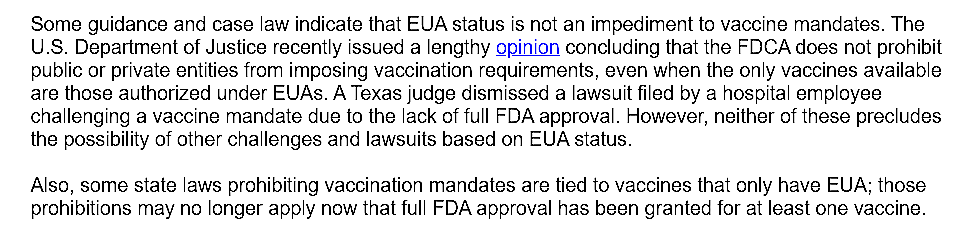
- Current Lack of Full FDA Approval for Some Vaccines. While the U.S. Food and Drug Administration (FDA) has now granted full approval to the Pfizer vaccine, Moderna and Johnson & Johnson’s Janssen vaccine maintain Emergency Use Authorization (EUA) status. This distinction may be important to employers because the Food, Drug, and Cosmetic Act (FDCA) includes a condition that potential recipients of an EUA product “are informed” of certain things, including “the option to accept or refuse [vaccination] administration.” Given that different vaccine clinics and other locations offering vaccines typically only offer one type, employers may want to consider how to provide information to employees regarding availability of certain vaccines or consider allowing more time for employees to obtain a particular vaccine.
- Collective Bargaining Obligations. Implementation of a vaccine requirement is likely a mandatory subject for collective bargaining, requiring employers to negotiate with the union representing unionized employees. Also, the union may request bargaining about the impact of a decision to mandate vaccination, requiring bargaining about issues like testing, union representation through the exemption process, and leave requests.
- Concerns of Vaccinated Employees. Vaccinated employees may be worried about interacting with colleagues in the workplace who are unvaccinated. Employees may have young children at home who are unable to get the vaccine or family members living in the same household who are immunocompromised. Some employees may feel their employer should take more action with regard to vaccinations in order to ensure a safe and healthy workplace. Section 5(a)(1) of the Occupational Safety and Health Act contains a general duty clause which may provide such employees with a tool to support a claim that the employer failed to provide a safe and healthy work environment.
Employers may wish to consider all options to determine what measures work best for their own workplace:
Option #1: Encourage Rather than Mandate
One option is to encourage, rather than mandate, the vaccine. This may include offering various incentives, such as cash, time off, transportation to employees related to receiving the vaccine, educating employees, and/or having management lead by example. Employers who still see a high percentage of unvaccinated individuals, however, may feel a mandate is more appropriate.
Option #2: Implement a Soft Mandate
Some employers have recently opted for a “soft mandate.” The soft mandate requires that unvaccinated employees practice certain precautions, such as wearing masks, social distancing, and weekly testing; employers also may limit or prohibit unvaccinated employees from work-related travel. This approach has been encouraged by President Biden for federal workers and contractors, and certain cities and states (such as New York City and the State of California) are taking similar approaches for their public workers. However, given reports that the virus can infect and be transmitted even by vaccinated employees, some of the precautions noted above (such as masking and social distancing) may be appropriate for all employees.
Option #3: Health Plan Premium Surcharges
Some employers are considering implementing a premium surcharge for unvaccinated employees participating in the employer’s health plan as an alternative to terminating unvaccinated employees. These surcharges are likely to range from twenty to fifty dollars, similar to surcharges imposed for employees who smoke. Delta Airlines, however, recently imposed a two-hundred-dollar surcharge per month on unvaccinated employees. COVID-19 diagnoses are likely to generate higher costs and health insurance premiums due to serious illness or hospitalization. However, this may violate the Americans with Disabilities Act (ADA) due to discrimination based on a health-related condition and as there is limited data evidencing unvaccinated employees actually result in higher costs compared to vaccinated employees.
Option #4: Implement a Hard Mandate
Of course, employers may pursue mandates with strong enforcement measures, such as termination, for employees who choose not to be vaccinated. Employers who impose a hard mandate should consider how much time is appropriate for allowing employees to become vaccinated. Because the Pfizer vaccine requires four weeks between the first and second doses, and another two weeks before the vaccine is fully effective, this timing should be considered in setting a time period. Similarly, employers may want to consider whether and how they would like to help provide access to the vaccine, such as by paying for transportation, providing time off from work, or holding a clinic at the workplace. Employers also should consider how they will communicate and distribute information regarding the COVID-19 vaccine and any associated policies to employees and employee expectations, how they will track which employees who have obtained the vaccine, and how they will address relevant questions or concerns from employees. Additionally, employers may find it helpful to provide their employees with information regarding the business reasons for the mandate and the benefits of the mandate. Employees terminated for not complying with their employer’s vaccine mandate may not be eligible for unemployment benefits; their ability to do so will likely depend on state regulations as well as the appetite of unemployment compensation commissions (and employers) to deprive workers of any benefits.
Employers are encouraged to speak with competent legal counsel about these issues.
Copyright © 2021 Robinson & Cole LLP. All rights reserved.
Article By Stephen W. Aronson, Natale V. Di Natale, Jean E. Tomasco and Kayla N. West of Robinson & Cole LLP