International Trade Commission Rules Lack of Domestic Industry Results in a Termination of Investigation

VedderPriceLogo

The International Trade Commission (ITC) is an independent, quasi-judicial agency that adjudicates the importation of products that allegedly infringe U.S. intellectual property rights. The ITC can halt the importation of goods that infringe U.S. patents and/or trademarks, and thus is an effective tool for obtaining a relatively rapid determination of infringement (one year) and an exclusion order. One of the requirements for such an order is to prove harm to a domestic industry. The following case (ITC investigation 337-TA-874) is an example of one way that such an investigation can be defeated.

In a recent decision, the ITC ordered an investigation into whether certain laminated products infringed the claims of a nonpracticing entity’s (NPE) patent. In initiating the investigation, the ITC ordered the administrative law judge (ALJ) overseeing the investigation to hold a preliminary hearing and to issue a decision as to whether the NPE has the required domestic industry in the United States to bring an investigation before the ITC. A finding of a lack of domestic industry would result in a termination of the investigation, as the NPE would not have standing with the ITC. This is a departure from current ITC practice, and it may provide an effective tool for preventing NPEs from bringing frivolous suits before the ITC.

Under 19 U.S.C. § 1337(a), the ITC has jurisdiction to hear matters in which a party alleging infringement (the complainant) has, or is in the process of establishing, a domestic industry in the United States. The determination of domestic industry is a two-prong test. The first prong, referred to as the “technical prong,” requires the complainant to show that it is practicing a valid claim of each asserted patent in a product sold in the United States. The analysis of the technical prong is similar to an infringement analysis, in which each claim is compared to the domestic product.1 The second prong of the test, referred to as the “economic prong,” requires the complainant to demonstrate “(a) a significant investment in plant and equipment, (b) significant employment of labor and capital, or (c) a substantial investment in its exploitation, including engineering, research and development, or licensing.”2

The complaint in the present investigation (337-TA-874) was brought by Lamina Packaging Innovations, an NPE, against a group of companies including Hasbro, John Jameson Import Company, Cognac Ferrand USA, Inc. and Camus Wines & Spirits Group. In the investigation, Lamina Packaging alleged that the respondents were infringing two of Lamina’s patents directed to a packaging material. In initiating the investigation, the ITC ordered the ALJ to issue an initial determination as to whether Lamina has satisfied the economic prong of the domestic industry requirement. Further, the ITC stated that the initial determination would become the ITC’s final determination 30 days after the date of service of the initial determination. Accordingly, a finding of no domestic industry by the ALJ would result in a termination of the investigation. The ITC ordered the ALJ to issue a decision on domestic industry within 100 days from the institution of the investigation.

Typically, lack of domestic industry is an affirmative defense presented by a respondent. The new ruling by the ITC may allow respondents to terminate ITC investigations early, opposed to the current practice that requires respondents to endure a summary judgment motion or a trial before a domestic industry decision is rendered. As more NPEs file complaints with the ITC in an attempt to “test run” future district court cases, this recent decision may greatly reduce the number of NPE cases filed with the ITC.


1 Alloc, Inc. v. Int’l Trade Comm’n, 342 F.3d 1361, 1375 (Fed. Cir. 2003).

2 19 U.S.C. § 1337(b).

Article By:

 of

False Marking Claims Must Be Pled with Specificity as to Intent

McDermottLogo_2c_rgb

The U.S. Court of Appeals for the Federal Circuit settled a split among the district courts when it held that false patent marking claims must be pled with particularity under Fed. R. of Civ. Pro. 9(b).   In granting the defendant’s petition for a writ of mandamus, the Federal Circuit held that the district court should have dismissed a false marking complaint for failure to plead, with particularity, the circumstances of defendant’s alleged intent to deceive the public.   In re BP Lubricants USA Inc., Misc. Docket No. 960 (Fed. Cir., Mar. 15, 2011) (Linn, J.).

The plaintiff had included in its complaint allegations that BP was a “sophisticated company” having experience applying for, obtaining and litigating patents.   Based on that categorization, the plaintiff claimed BP “knew or should have known” that the patent had expired.   The district court concluded that the complaint satisfied the requirements of Rule 9(b) because it had pled the who, how, what and when of the alleged fraud.  BP sought mandamus at the Federal Circuit.

The Federal Circuit clarified that in all cases sounding of fraud or mistake, Rule 9(b) requires the plaintiff to plead “with particularity the circumstances constituting the fraud or mistake.”   The Court noted that Rule 9(b) acts as a “safety valve to assure that only viable claims alleging fraud or mistake are allowed to proceed to discovery.   … Permitting a false marking complaint to proceed without meeting the particularity requirement of Rule 9(b) would sanction discovery and adjudication for claims that do little more than speculate that the defendant engaged in more than negligent action.” The Court stated that the district court erred in denying BP’s motion to dismiss because it expressly relied on the plaintiff’s general allegations that BP knew or should have known that the patent expired. The Court explained that a complaint must provide some objective indication to reasonably infer that the defendant was aware that the patent expired.  Accordingly, general allegations that the defendant is a “sophisticated company” and that it “knew or should have known” that the patent expired are insufficient under Rule 9(b).

The Court went further and provided exemplary allegations with which a court may reasonably infer an intent to deceive, “[alleging that a] defendant [had] sued a third party for infringement of a patent after the patent had, e.g., expired or made multiple revisions of the marking after expiration” may set forth facts upon which intent to deceive can be reasonably inferred.

 of

Replication without Human Intervention: Lessons from Monsanto v. Bowman

VedderPriceLogo

Until now, the practicing of an invention needed some direct form of human action; someone was needed to “do something” to bring the invention into existence, as well as replicate it by making more (in the case of a physical object) or performing it again (in the case of a method). However, this may no longer be necessary in all instances. At least in the case of some biological technologies, once an invention has been created by a human, further human intervention may no longer be needed for replicating the invention. In these instances, does a patent owner lose the right to exclude future uses, sales, offers for sale or importations of such an invention?

In Monsanto v. Bowman, the Supreme Court is poised to bring some clarity to this question. Monsanto Company designs and manufactures herbicide-resistant soybean seeds and related technology. Monsanto sold patented seeds to farmers for growing and resale as commodity items to be used in such things as public-school lunches and animal feed. Such sales were made under license agreements that allowed the beans to be sold without any ongoing restrictions on the use of those beans.

Vernon Bowman is a soybean farmer. Bowman purchased these beans and replanted them as second-generation seeds, which were the products of seeds purchased from a licensed Monsanto technology distributor.

Monsanto sued Bowman for patent infringement, arguing that the beans were products of Monsanto’s patented herbicide-resistant seeds and that, by planting them instead of purchasing new seeds, Bowman violated the Monsanto Technology Agreement for the seeds. The U.S. District Court found that Bowman’s activities infringed upon Monsanto’s patent and awarded damages to Monsanto for violation of its patented technology. The Federal Circuit agreed and upheld the decision, holding that Monsanto’s patent covered both the original seeds and a product of the original seeds, such as those second-generation beans grown by Bowman.

Bowman appealed, arguing that, under the doctrine of patent exhaustion, Monsanto’s patent rights were exhausted upon its initial sale of the seeds that Bowman later purchased from the licensed distributor, and that use of progeny seeds is an expected use of the product. In response, Monsanto argued that in the case of self-replicating technologies, such as seeds that grow and produce more seeds, the patent extends to the underlying technology (i.e., herbicide resistance) and not only to the seed itself.

The important question raised in this case is whether an exception to the doctrine of patent exhaustion for self-replicating technologies is needed and/or warranted. While this question is clearly important to the biotechnology and agricultural industries, it also has the potential to significantly affect the software and robotics industries. For example, as robotics and artificial intelligence become increasingly sophisticated in their abilities to adapt and “grow,” it does not seem too outlandish to think that, one day, these may also become self-replicating technologies.

Article By:

 of

National Labor Relations Board (NLRB) Issues Guidance on Lawful Confidentiality Language

DrinkerBiddle

On July 30, 2012, the NLRB (“Board”) issued a decision in Banner Health System dba Estrella Medical Center, 358 NLRB No. 93 holding, among other things, that the employer violated Section 8(a)(1) (which prohibits employers from interfering, restraining or coercing employees in the exercise of their rights), by restricting employees from discussing any complaint that was then the subject of an ongoing internal investigation.

To minimize the impact of such a confidentiality mandate on employees’ Section 7 rights, the Board found that an employer must make an individualized determination in each case that its “legitimate business justification” outweighed the employee’s rights to protected concerted activity in discussing workplace issues.  In Banner Health, the employer did not carry its burden to show a legitimate business justification because it failed to make a particularized showing that:

  • Witnesses were in need of protection;
  • Evidence was in danger of being destroyed;
  • Testimony was in danger of being fabricated; or
  • A cover-up must be prevented.

The Board concluded that the employer’s one-size-fits-all rule, prohibiting employees from engaging in any discussion of ongoing internal investigations, clearly failed to meet these requirements.

More recently, the NLRB’s Office of the General Counsel clarified the limits of how such policies could be drafted without running afoul of Section 7 in an advice memorandum released on April 24, 2013 (dated January 29, 2013).   The Region had submitted Verso Paper, Case 30-CA-089350 (January 29, 2013) to the Office of the General Counsel for advice regarding the confidentiality rule at issue and whether it unlawfully interfered with employees’ Section 7 rights.  Specifically, the Verso Code of Conduct contained this provision prohibiting employees from discussing ongoing internal investigations:

Verso has a compelling interest in protecting the integrity of its investigations.  In every investigation, Verso has a strong desire to protect witnesses from harassment, intimidation and retaliation, to keep evidence from being destroyed, to ensure that testimony is not fabricated, and to prevent a cover-up.  To assist Verso in achieving these objectives, we must maintain the investigation and our role in it in strict confidence.  If we do not maintain such confidentiality, we may be subject to disciplinary action up to and including immediate termination.

Reiterating that employees have a Section 7 right to discuss disciplinary investigations of their co-workers, the General Counsel’s Office found that the Verso Paper provision did not allow for a case-by-case analysis of whether or not the employer’s business justification for the restriction outweighed the employees’ Section 7 rights as required by Banner Health.  According to the General Counsel’s Office, the employer may establish this by presenting facts specific to a given investigation that give rise to a legitimate and substantial business justification for imposing confidentiality restrictions.

However, in footnote 7 of its advice, the General Counsel’s Office, after noting that the first two sentences of the Verso Paper rule lawfully set forth the employer’s interest in protecting the integrity of its investigations, surprisingly put forward a modified version of the remainder of the Verso Paper provision that it said would pass muster under Banner Health:

Verso may decide in some circumstances that in order to achieve these objectives, we must maintain the investigation and our role in it in strict confidence.  If Verso reasonably imposes such a requirement and we do not maintain such confidentiality, we may be subject to disciplinary action up to and including immediate termination.

Although this guidance is not binding, combining this language above with the first two sentences of the Verso Paper provision could certainly strengthen an employer’s argument that its intent was not to violate an employee’s Section 7 rights, but rather, to lawfully put employees on notice that if the employer “reasonably” imposes a confidentiality requirement, they must abide by it or face discipline.  However, employers must remain mindful that using a provision like this suggested does not obviate the need for the employer to engage in the particularized case-by-case determination of its substantial and legitimate business need that would permit it to impose confidentiality restrictions on the investigation.

Article By:

 of

Twitter: Little Statements with Big Consequences for Companies

McBrayer

Twitter is under attack. In recent months, accounts belonging to media giants CBS, BBC, and NPR have all been temporarily taken over by hackers. The Associated Press is the most recent victim. On April 23, 2013, a false statement about explosions at the White House and the President being injured sent shock waves through the Twitter-sphere. The real surprise is the effect the single tweet had in the real world: the Standard & Poor’s 500 Index dropped so sharply moments after the frightening tweet that $136 billion in market value was wiped out. While the hacking of these massive media outlets make headlines, everyday businesses are not safe from the threat, either. In February of this year, a hacker changed the @BurgerKing feed to resemble that of McDonald’s, putting the McDonald’s logo in place of Burger King’s. The hackers posted offensive claims about company employees and practices. If accounts belonging to well-established companies like these are vulnerable, so is yours. If a tweet can have a profound impact on the nation’s stock market, imagine what an ill-contrived tweet could do to your business.

Business owners may have the knee-jerk reaction to delete their Twitter account, but despite the recent blemishes to its security, Twitter remains one of the most important social media sites out there. Just recently, the Securities Exchange Commission made clear that companies could use social media like Twitter when announcing key information in compliance with Regulation Fair Disclosure. Twitter is not just a marketing or PR tool—Twitter is business. And you should never turn your back on existing business. So instead of hanging up your hashtags, consider some steps that can make your Twitter account safer.

Limit Access

Not every employee should have access to the company’s Twitter account. In fact, hardly anyone should, except a few designated employees like the marketing director or business owner. While those with access may never do anything harmful to the account, the more people who have the log-in information, the more likely it is to fall into the wrong hands.

Create a strong password

I know, you already have too many passwords to remember. But a creative password is your best defense against someone seeking to break into your account. Employers should, at minimum, have unique passwords for their most commonly used media sites; please do not use the same word for your Facebook, LinkedIn, and Twitter account. Once a hacker figures it out, they have control of your entire social media presence.

When creating a password, avoid using anything that would be too common. “Password,” “1234,” or the business’s name should never be the only thing standing between you and a hacker. The longer the password, the better. Use a mix of uppercase and lowercase letters, numbers, and symbols.

Article By:

 of

Federal Trade Commission’s (FTC) New Chairwoman Ramirez Says Health Care Continues To Be Top Priority

McDermottLogo_2c_rgb

In remarks made this week at the International Competition Network annual conference, Federal Trade Commission (FTC) Chairwoman Edith Ramirez stated that health care will continue to be a top priority for the FTC.   Referring to health care and hospital mergers in particular, she said that the Commission will “guard[] against what we consider to be consolidation that may end up having adverse consequences for consumers.”  The Chairwoman’s comments indicate that the recent leadership change at the FTC from former Chairman Jon Leibowitz to Chairwoman Ramirez has not altered the Commission’s priorities.

Recent months have seen a flurry of FTC activity in the courts related to health care.  For example, two FTC cases came before the U.S. Supreme Court this term — the FTC’s challenge to Phoebe Putney’s acquisition of Palmyra Park Hospital in Georgia and the FTC’s challenge to “pay-for-delay” patent infringement litigation settlements between branded and generic pharmaceutical manufacturers.

In February, the Supreme Court ruled that the state action doctrine did not immunize Phoebe Putney’s hospital transaction from federal antitrust scrutiny, and the FTC has subsequently filed renewed motions in federal district court to stop further integration of the two hospitals even as it prepares for a full administrative hearing on the merits that will begin in August.

A decision on the “pay-for-delay” case is expected in June.  The Supreme Court’s ruling may have a large impact on further FTC efforts against what it perceives as anticompetitive efforts to delay generic drug entry.

Health care clients considering acquisitions are advised to consult antitrust counsel early in the transaction process.  Given the FTC and DOJ’s close scrutiny of health care transactions, early advocacy before the antitrust agencies is often critical to a deal closing on schedule.

Article By:

 of

Automation of U.S. Customs & Border Protection (CBP) Form I-94 and Release of New Immigration Form I-9

VedderPriceLogo

Visitors to the United States May Need to Print Form I-94 Arrival/Departure Records

U.S. Customs & Border Protection (CBP) will begin a new program on April 30, 2013 that will end issuance of paper Form I-94 Arrival/Departure Records for many visitors. Foreign visitors arriving in the United States via air or sea who need to prove their lawful immigration status will be required to access their arrival information online and print their own Form I-94 Arrival/Departure Records (Form I-94). A hard copy of Form I-94 is required to begin employment, apply for a Social Security Number, and obtain a driver’s license or identification document.

CBP indicated that it expects this automation to save the government an estimated $15.5 million per year. Because advance information is transmitted only for air and sea travelers, CBP will continue to issue paper Forms I-94 at land border ports of entry.

CBP will phase in the I-94 automation at air and sea ports of entry in April and May. Foreign visitors will continue to receive a paper I-94 until the automated process arrives at their port of entry. If a visitor does not receive a paper Form I-94 record to verify immigration status or employment authorization, the record number and other admission information will be available here. A CBP officer will stamp the travel document (passport) of each arriving nonimmigrant traveler showing the date of admission, class of admission and the date until which the traveler is admitted. The visitor will not need to print Form I-94 to provide to the government upon departure. A CBP Fact Sheet may be found here.

All U.S. Employers Required to Use New Employment Eligibility Verification Form I-9 as of May 7, 2013

U.S. Citizenship and Immigration Services (USCIS) will require all U.S. employers to use its revised Employment Eligibility Verification Form I-9 as of May 7, 2013. All employers are required to complete an Employment Eligibility Verification Form I-9 (Form I-9) for each new employee hired in the United States. The updated Form (Revision Date 03/08/13) includes new information fields and has been expanded to two pages. USCIS has stated that the new formatting will reduce errors and provide clearer instructions for both employees and employers. The List of Acceptable Documents has not changed.

Employers should NOT require current employees to complete the new Form I-9. The new Form will be used only for new employees or when reverifying the work authorization for current employees. The new employee may complete the Form after acceptance of the job offer, and no later than the first date of hire. The new instructions confirm that an employer has three business days to complete the Form; in the case of reverification, the employer must re-verify the document(s) before the work authorization expires.

The new Form I-9 does NOT change any requirements relating to remote hires. USCIS’s position is that the employer representative who signs the attestation must be the same person who physically examines each original document to determine if it reasonably appears to be genuine and relates to the employee. An employer with remote hires may delegate the verification to a person who serves as an agent of the employer, but that agent must examine the documents and complete Section 2 or Section 3 of the Form I-9. The employer retains the liability for the actions of the agent.

A Spanish language version of the new Form is also available on the USCIS website for use in Puerto Rico only. Spanish-speaking employers and employees in the 50 states, Washington, DC, and other U.S. territories may refer to the Spanish version but must complete the English-language version of the Form.

Employers may receive monetary fines for all substantive and uncorrected technical Form I-9 violations. Penalties for these violations, which include failure to utilize the correct version of the Form I-9, range from $110 to $1,100 per violation.

 of

Early Patent Trial and Appeal Board Orders Demonstrate Differences Between America Invents Act (AIA) Patent Trials and District Court Trials

Schwegam vertical logo

Patent practitioners are still absorbing some of the differences and advantages that are unique to litigation in the PTAB as opposed to district court litigation.  For example, PTAB proceedings only decide questions of validity and are not directed to rule on questions of infringement or damages, as is the practice in traditional litigation.  Another example is that PTAB trials require that the petitioner provide a lot of technical arguments and factual evidence in the original petition, as opposed to traditional litigation where parties make sure they have a good faith basis to sue and then rely on discovery to later develop the case.  Thus, a petition for review of patentability in PTAB practice is more akin to a summary judgment motion than a complaint in trial practice.  But a PTAB petition is still very different than a summary judgment motion.  And these differences can be exploited to more inexpensively and quickly resolve validity issues.

In considering summary judgment, a judge must decide if there is “no genuine dispute as to any material fact,” as set forth in FRCP Rule 56.  In contrast, the technical patent judges on the Board can decide technical disputes instantly and can resolve disputes of technical and legal nature.  PTAB panels use their technical and patent law experience to quickly identify dispositive issues and focus the parties on how their respective positions are being viewed by the Board early in the proceedings.  This means that PTAB trials will put a premium on identification of technical defects in patents early in the proceedings, as opposed to traditional litigation approaches that favor discovery before attempting summary judgment or that shy away from summary judgment as a mechanism for resolution of complex technical disputes.

Examples of the Board’s unique capabilities are already being demonstrated in recent orders.  For example, in an inter partes review by Chimei Innolux Corporation against Semiconductor Energy Laboratory Co.,Ltd. concerning U.S. Patent No. 8,068,204 (IPR2013-00068), the Board squarely addressed technical disputes between what the petition asserted versus what the patent owner’s preliminary statement set forth when the Board decided to institute trial.

The Board took great care to understand and sift through extremely technical differences between the claimed subject matter and the prior art as it was characterized by the parties.  This is a highly complicated task, because the patent relates to improvements for substrate bonding and electrical connections in liquid-crystal displays and because the parties were advancing very technical arguments on both sides of the validity issue.  In this early order to institute trial the Board construed a phrase from the claims and used that construction to decide the merits of the positions taken by the petitioner and patent owner.  The Board then considered technical arguments made by both parties, such as whether a reference used in combination in an obviousness challenge teaches away from the combination (page 15), or whether it would have been obvious to employ a known (contact) structure (page 18).  The Board decided that certain arguments were not persuasive and used the order to focus the parties on the issues it ruled upon.  The following excerpt from pages 19-21 of the the order instituting trial demonstrates the attention to detail that the Board is devoting to these proceedings:

SEL responds that “[. . .] a person of ordinary skill in the art does not know whether an insulating film (first insulating film) is formed between the bottom layer of the first wiring line 127 (formed in the step of forming the scanning lines Yj) and the top layer of the first wiring line 127 (formed in the step of forming the data lines Xi).” (Prelim. Resp. 31.) According to SEL, Shiba’s “‘two-layered structure’” might be “sequentially stacked” without an insulating layer therebetween. (Id.) As noted, claim 31 requires such an intervening insulating layer.

SEL’s argument is not persuasive. Shiba implies or suggests that the two wiring layers in the two-layered structure 127, formed in the same manner as the two-layered scanning and data lines as the quoted passage shows, have an insulating layer therebetween just like the scanning and data lines. [cite omitted]  [. . .  .]  Skilled artisans also would have understood that overlapping portions readily could have been “partially connected” together by known methods, including using a connecting hole through such an insulating layer. [cite omitted]

Because the two-layered structure in Shiba’s lines 127 connect to pad 751, SEL maintains that under various hypothetical scenarios, pad 751 also must have a two-layered structure, and as such, with Sukegawa’s transparent layer modified to be on Shiba’s pad as CMI proposes in its ground of unpatentability, the pad structure would become a three-layered structure. . . .  SEL also argues that the Petition inconsistently conflates or interchanges Sukegawa’s transparent layer and the top layer of Shiba’s two-layered wiring structure 127, and thereby fails to show how the combination renders obvious the external connection line and transparent conductive film as recited in claims 31 and 54. (See Prelim. Resp. 25-26.)

It is clear from the analysis set forth by the Board that it is not afraid to weigh in on very technical issues and clarify how it perceives the arguments.  Of course, the preliminary response by the patent owner is considered a first initial response and is not a comprehensive response with evidence.  Therefore, the Board’s institution of trial is based on limited argument and is well before the patent owner has had an opportunity to fully respond.  But this process focuses the parties on issues that the Board (at least initially) perceives to be negative to the patent.  It is a preliminary ruling on the disputed issues by the Board that will shape discovery to come, as opposed to traditional litigation where discovery often leads and shapes the issues brought before the court.

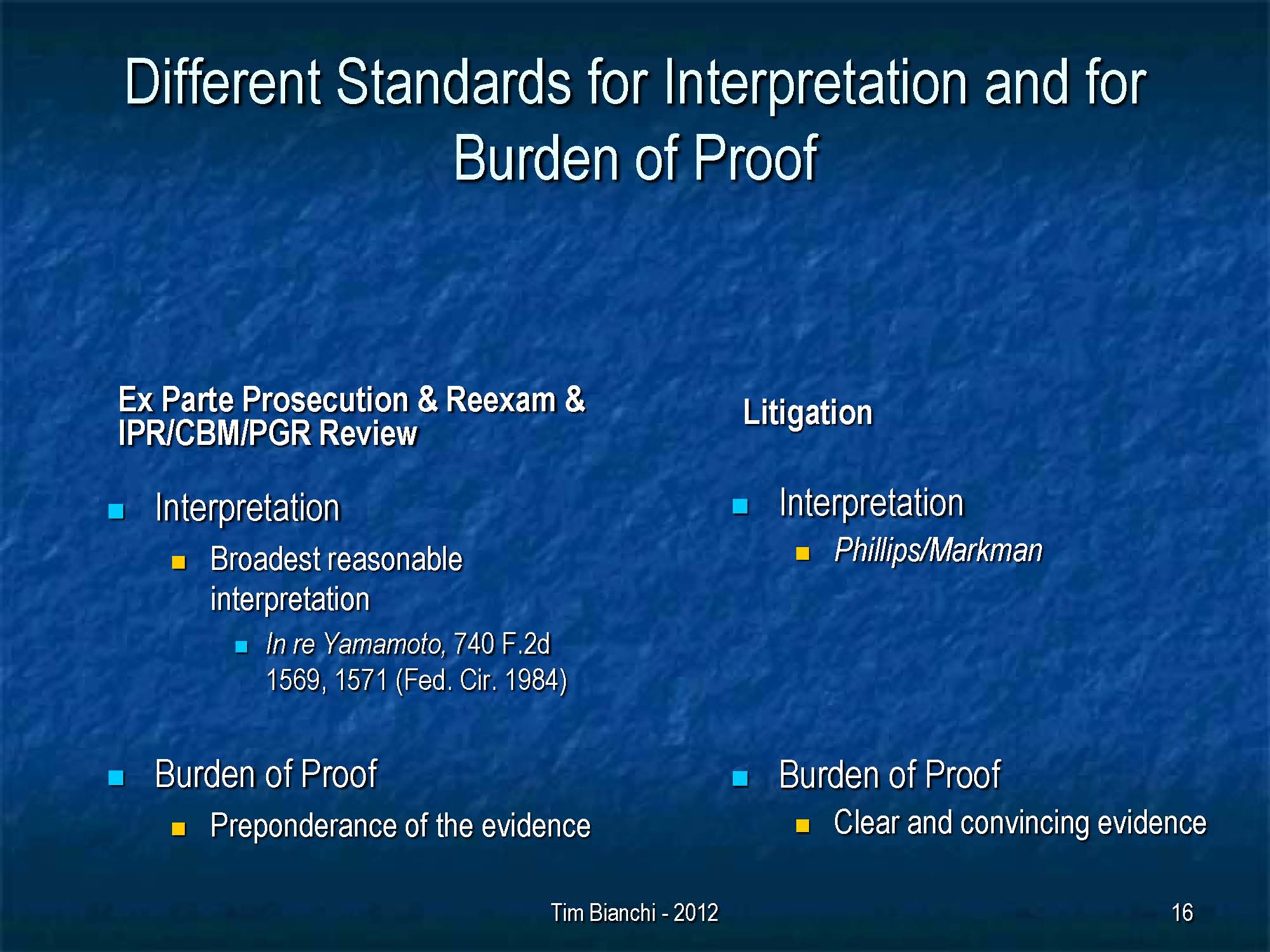
Parties who believe that an asserted patent has validity issues may find it difficult to challenge disputed technical issues in summary judgment motion practice.  Validity issues are frequently accompanied with fact questions and in litigation there is a clear and convincing standard for invalidity that makes it hard to prove invalidity.  And it is unlikely that counsel will recommend a motion for summary judgment before conducting at least some discovery.  In contrast, in patent reviews and reexaminations the burden of proof is based on a preponderance of the evidence and can be done without discovery.  Given the different standards and the costs of e-discovery, there are significant advantages to the PTAB patent review option for defendants with genuine validity arguments.  But one must be careful to choose the PTAB trial option carefully to avoid estoppel should the proceeding not result in destruction of the relevant patent claims.

Article By:

 of

Takeover Code Amendments Extend the Rights of Pension Scheme Trustees

Morgan Lewis logo

Amendments include new requirements regarding offerors’ intentions, documents provided to trustees, trustees’ opinions on offers, and publication of agreements between offerors and trustees.

On 22 April, the Code Committee of the UK Panel on Takeovers and Mergers (the Panel) published response statement RS 2012/2 (the Response Statement), which introduces amendments to the City Code on Takeovers and Mergers (the Code).[1] The Response Statement follows a consultation to consider extending the rights of trustees of offeree company pension schemes. Broadly, the amendments to the Code provide the following:

  • An offeror is required to state its intentions with regard to the offeree company’s pension scheme.
  • Certain information is required to be published in the offer document or otherwise provided to pension scheme trustees.
  • Trustees are allowed to provide an opinion on the effects of an offer on the company’s pension scheme.
  • Agreements between an offeror and pension scheme trustees that relate to pension scheme funding may be required to be published if they are material.

Background

On 19 September 2011, significant changes were made to the Code, including an extension of the obligations of the offeror and offeree in relation to information to be provided to, and the obligation to publish opinions of, the offeree company’s employees and employee representatives. During the Panel’s consultation on those changes, the pensions industry lobbied significantly for similar provisions to be added to the Code in relation to trustees of pension schemes. Proposed amendments to the Code were published in public consultation paper PCP 2012/2 (the PCP)[2] on 5 July 2012, and a period of consultation followed. The Response Statement sets out the Panel’s response to that consultation and the resulting changes to be made to the Code. Although many of the changes will be adopted as originally proposed in the PCP, certain modifications have been made.

In determining the new regime, the Panel has been mindful that the intended effect of the changes is to create a framework within which the effects of an offer on an offeree company’s pension scheme can become (i) a debating point during the course of the offer and (ii) a point on which the relevant parties can express their views.

Application of New Code Provisions to Defined Benefit Schemes

The new provisions of the Code are limited to funded pension schemes sponsored by the offeree (or any of its subsidiaries) that (i) provide pension benefits (either in whole or in part) on a defined benefit basis—and (ii) have trustees (or managers, in the case of non-UK schemes). The Code provisions are not limited to UK pension schemes and apply to all such schemes, regardless of size or materiality in the context of the offeree’s group.

The new provisions do not apply to pension schemes that provide pension benefits only on a “defined contribution” basis, as the Panel believes that the provisions of the Code granting rights to employees and employee representatives already create an appropriate framework for discussion in relation to the impact of an offer, and the offeror’s intentions, in relation to such schemes.

Publication of Offeror’s Intentions in Relation to Pension Scheme

An offeror will now be required to include in the offer document a statement of its intentions with regard to relevant offeree pension schemes, including with respect to employer contributions and arrangements for deficit funding, benefits accruals for current members, and the admission of new members to the scheme. However, the Panel has not required that the offeror include a statement on the likely repercussions of its strategic plans for the offeree company on relevant pension schemes. Similarly, the Panel has confirmed that such statements do not need to include an assessment of the future ability of the offeree company to meet its funding obligations to its pension scheme.

The Panel also confirmed that the general rule under Note 3, Rule 19.1 of the Code will apply to statements of intention made in respect of pension schemes. This means that an offeror will be considered to be committed by any such statements for 12 months after the offer ends (or such other period of time as is specified in the offeror’s statement), unless there has been a material change of circumstances.

Under the PCP, the Panel originally proposed to require the offeree to include in its offeree circular its views on the effects of the implementation of the offer—and the offeror’s strategic plans for the offeree—on the offeree’s pension schemes. However, following the consultation, the Panel did not make these changes but did confirm that the offeree board may include its views on these subjects in the offeree circular should it wish to do so.

Provision of Information to Pension Scheme Trustees

The amendments to the Code provide that trustees of the offeree company’s pension scheme will be entitled to receive the same documents that offerors and offerees are required to make available to employee representatives. These documents include the following:

  • The announcement that commences the offer period
  • The announcement of a firm intention to make an offer
  • The offer document
  • The offeree board circular in response to the offer document
  • Any revised offer document
  • The offeree board circular in response to any revised offer document

Pension Scheme Trustees’ Opinion on the Offer

Under the revised Code, pension scheme trustees will have the right to require the offeree’s board of directors to publish the trustees’ opinion on the effects of the offer on the pension scheme, and the offeree will be obliged to notify such trustees of this right at the commencement of the offer. As with employee representatives’ opinions, if the trustees’ opinion is received in good time, the opinion must be appended to the offeree board circular. If it is not received in good time, it must be published on a website, with such publication to be announced on a Regulated Information Service.[3] The Panel has confirmed that the trustees’ opinion may cover more than the impact of the offer on the benefits that the scheme provides to members (and other matters to be included in the offeror’s statement in the offer document) and that the opinion may also extend to the trustees’ views on the impact of the offer on the post-offer ability of the offeree company to make future contributions to the pension scheme (i.e., the strength of its funding covenant).

Unlike employee representative opinions, the offeree will only be responsible for the costs incurred in the publication of the trustees’ opinion and not for any other costs incurred in relation to its preparation or verification.

Agreements Entered into Between an Offeror and Pension Scheme Trustees

The revised Code also contains certain provisions relating to any agreements between an offeror and the trustees of an offeree pension scheme, for example, in relation to the future funding of that scheme. Following the consultation, the Panel determined that any such agreements should be treated in the same manner as any other offer-related agreement, with certain variations. As a result, the amendments contain the following requirements for agreements between offerors and pension scheme trustees:

  • Where any such agreement is a material contract for the offeror within the meaning of the Code, it should be published on a website in the same manner as any other material contract.
  • Where such an agreement is not material, but is nevertheless referred to in the offer document, there will be no requirement to publish it on a website.
  • Where such an agreement relates only to the future funding of the pension scheme, it will be excluded from the general prohibition on offer-related agreements contained in Rule 21.2(a).[4]

Pensions Regulator

The Panel has confirmed, following discussions with the UK Pensions Regulator, that there will be no obligation under the Code for the offeror or offeree to send offer-related documentation to the Pensions Regulator, nor will there be any obligation on the Panel to notify the Pensions Regulator of takeover offers. Accordingly, it is for the offer parties (and any other interested parties) to decide whether they wish to engage with, or seek clearance of the offer from, the Pensions Regulator.

Entry into Force

The amendments introduced by the Response Statement will take effect on 20 May 2013, and an amended version of the Code will be published on this date.


[1]. View the Response Statement here.

[2]. View the PCP here.

[3]. The UK Financial Conduct Authority has published a list of information services that are approved Regulated Information Services in Appendix 3 of the Listing Rules, which is available here.

[4]. The Panel, however, emphasised that any obligations or restrictions on the trustees regarding any other offeror or potential offeror would not be permissible.

Article By:

 of

Making Copies! The Fourth Circuit Defines Taxable Costs Associated With eDiscovery

GT Law

Can this happen to your client? Your client gets sued, is forced to spend over $100,000 on eDiscovery despite you making all the right objections, you deliver a clean victory on dispositive motions and the District Court awards costs of … $200. Here is what happened in the Fourth Circuit and what you can do to help your clients avoid the same fate:

The Fourth Circuit just decided the scope of taxable eDiscovery costs under 28 U.S.C. § 1920(4) in Country Vintner of North Carolina v. E. & J. Gallo Winery, Inc., __ F.3d __, 2013 WL 1789728 (4th Cir. Apr. 29, 2013). Section 1920(4) allows the District Courts to “tax as costs … [f]ees for exemplification and the costs of making copies of any materials where the copies are necessarily obtained for use in the case.” Id.   Under Federal Rule of Civil Procedure 54(d)(1), the cost of making copies “should be allowed to the prevailing party.” As an initial matter, the Fourth Circuit concluded that section 1920(4) applies to the costs related to documents produced in discovery – not just used at trial or in connection with a dispositive motion. Country Vintner, 2013 WL 1789728, *7. The Fourth Circuit then examined the meaning of “making copies,” and held that section 1920(4) “limits taxable costs to … converting electronic files to non-editable formats and burning files onto discs.” Id., *9.   In reaching that conclusion, the Fourth Circuit explicitly rejected the argument that “ESI processing costs constitute[d]” “making copies” under Section 1920(4). Id., *7. As a consequence, Appellant Gallo was awarded only $218.59 out of the $111,047.75 in eDiscovery costs it sought.

What does that mean?

Appellant Gallo sought more than $70,000 for “indexing” and “flattening” ESI – processing methods that extracted irrelevant files and duplicates, made the remaining data searchable, and organized the data; spent more than $15,000 extracting and organizing metadata and preparing it for review; less than $100 on electronic bates numbering; and over $20,000 on quality assurance and preparing the document production. None of these costs were taxed. Instead, Gallo received only $178.59 to convert certain native files into TIFF and PDF format and another $40 to burn images onto CDs. While the documents could not be “copied” without all of the processing that preceded it, such processing costs will not be shifted through a bill of costs. Id., *8-9 (citing Race Tires Am.supra n. 2, 674 F.3d at 169).

What lessons can we learn?

The Fourth Circuit seems to recognize the harshness of its ruling and provides two helpful clues for future litigants seeking to manage their eDiscovery burdens. The court first observes: “That Gallo will recover only a fraction of its litigation costs under our approach does not establish that our reading of the statute is too grudging in an age of unforeseen innovations in litigation-support technology.” Id., *9. Then, the court leaves open the question of whether the allowable costs of production might include the processing costs had the parties “clearly agreed to the production of ESI on a particular database or in native file format.” Id., *9 n. 20 (citing In re Ricoh Co., Ltd. Patent Litig., 661 F.3d 1361, 1365–66 (Fed. Cir. 2011) (holding that $234,702.43 for the cost of an electronic database which the parties agreed to use for document production would have been allowed, but for the parties’ agreement to share costs)). Next, the court points out that, where discovery costs are excessive, the responding party can move for a protective order and, if that motion is denied (as Gallo’s motion was denied), then the responding party “can appeal that decision” Id., *9; id., *9 n. 21 (noting that Gallo had not appealed the denial of its motion for protective order).

Lesson #1: While it is not entirely clear how the parties’ agreement to utilize a particular format or database alters the conclusion that processing is not “making copies,” the Fourth Circuit seems to suggest that it might.  So, any party seeking to shift its eDiscovery costs should consider agreeing with the other side regarding the format or database to be used to handle the parties’ productions.

Lesson #2: While it is not entirely clear whether parties are entitled to file an interlocutory appeal with respect to the denial of a motion for protective order, the Fourth Circuit seems to urge parties to do so. 4  Either the court is encouraging interlocutory appeals before the ESI expenses are incurred, or the court is suggesting that a final judgment (for either party) does not moot the trial court’s refusal to shift pre-trial eDiscovery costs.


 1 Because appellant Gallo’s eDiscovery costs neither involved authentication of public records nor demonstrative exhibits – two potential meanings of exemplification – the Fourth Circuit did not define the meaning of exemplification in this case.  Country Vintner, 2013 WL 1789728, *10.

 2 In reaching that conclusion, the Fourth Circuit aligned itself with the Third Circuit’s approach in Race Tires Am., Inc. v. Hoosier Racing Tire Corp., 674 F.3d 158 (3d Cir. 2012).

 In distinguishing In re Ricoh Co., the Third Circuit explained: “we have acknowledged that the costs of conversion to an agreed-upon production format are taxable as the functional equivalent of ‘making copies.’ It is all the other activity, such as searching, culling and deduplication that are not taxable.” Race Tires Am., 674 F.3d at 171 n.11.

 On one hand, discovery orders against a party are not immediately appealable. Seee.g.Nicholas v. Wyndham Int’l, Inc., 373 F.3d 537 (4th Cir. 2004). On the other hand, most discovery orders will be moot by the time a final order is entered. See, e.g., E. H. Reise v. Bd. of Regents of the Univ. of Wisconsin, Sys., 957 F.2d 293, 295-296 (7th Cir. 1992).

Article By:

 of