The First 48 Hours – A New OSHA COVID-19 Standard on the Way?

In President Biden’s first 48 hours on the job, he issued approximately 30 executive orders.  One of these is an Executive Order on Protecting Worker Health and Safety.  The Order, as the title implies, directs the federal government to “take swift action to reduce the risk that workers may contract COVID-19 in the workplace.” The Order further requires the issuance of “science-based guidance” to achieve this goal.

Under the Order, the Secretary of Labor (Al Stewart was designated as the Acting Secretary of Labor, effective January 20, 2021, pending Senate confirmation of the nominee, Boston Mayor Marty Walsh) is to:

  • By February 4 – issue “revised guidance to employers on workplace safety during the COVID-19 pandemic;”
  • Consider whether emergency temporary workplace standards are necessary, including wearing masks in the workplace – and, if deemed necessary – to issue the new standard by March 15;
  • Undertake a review of OSHA’s present enforcement efforts, and determine whether immediate or long-term changes are necessary to “better protect workers and to ensure equity in enforcement;”
  • Launch a national enforcement effort focused on COVID-19-related violations that put the largest number of workers at serious risk or are contrary to anti-retaliation principles; and,
  • Coordinate a multidepartmental, multilingual outreach campaign to educate workers on their rights under the safety and health laws, including through engagement with labor unions, community organizations and industries – with a special emphasis on communities that have been the hardest hit by the pandemic.

OSHA (the Occupational Safety and Health Administration) has a comprehensive web page devoted to COVID-19, which includes identification of applicable regulationsenforcement memoranda, recording and reporting requirements, links to various pandemic-related “tools” and “resources,” as well as specific workplace guidance by industry.

To date, OSHA had not issued any new temporary or other regulatory standards applicable to workplaces aimed specifically at COVID-19.  Rather, OSHA’s principal deputy assistant secretary under the Trump administration, Loren Sweatt, testified to Congress in 2020 that OSHA did not believe such new standards were necessary because “OSHA has standards in place to protect employees and employers who fail to take appropriate steps to protect their employees may be violating them. Such standards include conducting hazard assessments, ensuring sanitation and cleanliness, providing PPE, and requiring training and education, as well as the general duty clause itself.”

As the number of fatalities in the U.S. has more recently climbed exponentially, it is very likely that OSHA, under the Biden administration, will proceed in a different direction.  Stay tuned for further developments.


For more, visit the NLR Labor & Employment section.

President Biden Installs Two Deputy Assistant Secretaries at Workplace Safety and Health Agency to Jump-Start Agenda

On Jan. 19, 2020, the day before President Biden was sworn in as the 46th president of the United States, his transition team announced that James Frederick will be appointed deputy assistant secretary of labor for occupational safety and health, a non-Senate confirmed position. In this role, Mr. Frederick will run the Occupational Safety and Health Agency (OSHA) until President Biden nominates someone for assistant secretary of labor for occupational safety and health and the Senate confirms the nominee.

Since September 2019, Mr. Frederick has been a part-time consultant for ORC HSE Strategies, LLC, where he provided member employers with, among other things, advice on and assistance with regulatory and legislative matters and assessment and integration of health and safety management systems. Before that, he was assistant director of the Health, Safety & Environment Department of the United Steel, Paper and Forestry Rubber, Manufacturing, Energy, Allied Industrial and Service Workers International Union (USW), the largest industrial union in North America. As assistant director, Mr. Frederick testified before congressional panels and federal agencies regarding safety and health issues including workplace violence, beryllium, silica, hazard communication and ergonomics. Mr. Frederick worked for more than 20 years at USW, which represents workers employed in the metals, rubber, chemicals, paper, energy, and government and service sectors.

In addition to installing Mr. Frederick to a leadership position within OSHA, the new administration also announced that Joseph T. Hughes will serve as deputy assistant secretary for pandemic and emergency response for OSHA. Previously, Mr. Hughes was director of the National Institute for Environmental Health Sciences Worker Education and Training program, which provides grants to unions and nonprofit organizations to train workers on occupational safety and health.

It is unclear whether President Biden will formally nominate Mr. Frederick to be the permanent assistant secretary of labor for OSHA or whether Mr. Frederick will remain within the agency’s leadership if the president nominates someone else to head the agency. It is also unclear when President Biden will officially nominate someone for the position and when the Senate will hold a hearing on the nomination. As a point of reference, the Senate did not confirm Dr. David Michaels, assistant secretary of labor for OSHA during the Obama administration, until December 2009, nearly a year after President Obama assumed office.

Because a permanent assistant secretary of labor for OSHA will likely not be confirmed for at least a few months, if not more, Mr. Frederick and Mr. Hughes will likely play a significant role in jump-starting the Biden administration’s workplace safety agenda. This includes, among other things, assessing the need for and enacting an enforceable standard that would require employers to take steps to protect workers from contracting COVID-19 at the workplace. To the extent OSHA adopts an emergency temporary standard (or permanent standard) related to COVID-19, or infectious diseases more generally, OSHA may look to the COVID-19 safety and health regulations that “state-plan” states like Virginia, California, Oregon, and Michigan have enacted as a model.


©2020 Greenberg Traurig, LLP. All rights reserved.
For more, visit the NLR Labor & Employment section.

COVID-19 Weekly Newsletter: Biden Administration Rolls Out COVID-19 Response

Wednesday marked the beginning of a new presidency and with it a new chapter in the U.S. COVID-19 response. The Biden administration immediately unveiled a number of executive orders designed to take control of the pandemic.

Executive Orders & COVID-19 National Strategy

President Biden signed a series of executive orders (EOs) in his first two days in office intended to curb the pandemic — in the same week in which the total death toll exceeded 400,000. The COVID-19 EOs require face masks and social-distancing practices on federal property and while traveling via certain modes of domestic transportation; give the COVID-19 response coordinator the authority to convene and tap relevant domestic and global agencies to coordinate efforts; require all international travelers to the U.S. to have a negative test prior to entry; establish a COVID-19 Health Equity Task Force; enhance data collection and collaboration efforts; and establish a Testing Board and free testing — specifically closing a loophole that previously existed that allowed private plans to charge asymptomatic individuals who wanted to get tested on their own. In addition, Biden invoked the Defense Production Act to secure the supply chain of needed materials: vaccines, personal protective equipment (PPE), etc. On Thursday, Biden released a 200+ page strategy to combat the pandemic.

Vaccine Distribution Hiccups Nationwide

New York City had to cancel over 20,000 vaccine appointments this week as their supply ran dry, a step many other states had to take for similar reasons. The city is considering using its 65,000 stock of the second dose of the vaccine to close the supply gap. Some states are pulling back on their vaccine allocation criteria to narrow the number of eligible individuals to match their scarce supply. Last week’s White House announcement encouraging states to expand vaccination to individuals over 65 led many states to believe they would receive shipments from the feds to meet the new guidance; however, it was determined that the federal government’s stockpile was dried up as well. California is considering prioritizing those 65-plus over those with high-risk occupations for easier logistical distribution. In the meantime, Pfizer this week indicated interest in working with the Department of Health and Human Services (HHS) on a distribution model that would allow state governments to buy directly from them.

Sequencing COVID-19 Samples

The Centers for Disease Control and Prevention (CDC) on Monday secured a contract with Quest Diagnostics to do genomic sequencing of the COVID-19 virus. This news comes two weeks after LabCorp signed the same in an effort to expand the CDC’s genomic sequencing capabilities. The data from private laboratories will be combined with data coming from public health and academic laboratories nationwide to assist in identifying mutations, prevalence and patterns of transmission.

Concerns of New COVID-19 Variants

Several new variants of COVID-19 have been discovered recently in the U.K., Brazil, South Africa and possibly California. Preliminary reports indicate that while these variants are more easily transmitted, they do not seem to result in increased mortality. These new variants are raising concerns on the effectiveness of the three main COVID-19 vaccines from Pfizer BioNTech, Moderna and AstraZeneca currently being administered all target the spike protein (S-protein) where these variants have mutations. For the U.K. variant, it is predicted that these vaccines will still be effective, and preliminary data on the effectiveness of the Pfizer BioNTech vaccine supports that theory. For the South African variant, there is more concern that one mutation in the S-protein called E484K may reduce the effectiveness of the vaccines. Preliminary data on the South African variant has demonstrated that this variant is less affected by the immune responses from previous infections. The Brazil variant has been reported to have this same E484K mutation as the South African variant. More experiments are underway to further assess the effectiveness of the vaccines against these variants. It should be noted that if any of these and other variants are found to be less susceptible to these vaccines, given the high effectiveness of these vaccines they will likely still have levels of effectiveness above the World Health Organization threshold of 50%.

Vaccine Side Effects Continue To Be Studied

Vaccines being administered in the U.S. under emergency use authorization have been carefully studied in tens of thousands of people, and further studies are ongoing — in part, to better understand all possible effects of vaccines in diverse populations. For example, the age of participants ranged from 16 to 89 years old in the BNT162b2 vaccine study group and from 18 to 95 years old in the mRNA-1273 study, indicating the vaccines are safe and effective in both old and young adults. On the other hand, information about the impact of serious underlying health conditions and multiple medications is still limited. The vaccines have now been administered to millions of people, leading to a slow accumulation of observations of health problems and even deaths which occurred shortly after the vaccine administration and which may or may not have been caused by the vaccine — see herehere and here. Severe allergic reactions seem to be one of the acknowledged potential side effects, and a number of other possible reactions have now been documented, including itch, rash, swelling and mild respiratory symptoms. A continued collection and analysis of real-world data is critical to establishing the safest and most effective protocols to vaccinate entire populations.


© 2020 Faegre Drinker Biddle & Reath LLP. All Rights Reserved.
For more, visit the NLR Coronavirus News section.

Once More Into The Breach – Or Should That Be Conflict?

A common contractual representation is that the execution and delivery of the agreement does not constitute a breach of one or more other agreements or charter documents.  Sometimes, the representation is that the execution and delivery do not “conflict with” or “violate”.  Is there any difference between a “breach”, a “conflict” or a “violate”?

“Breach” is a word of Old English origin (bryce, meaning a fracture or breaking).  “Conflict” and “Violate” in contrast are of Latin origin.  At the siege of Harfleur,  King Henry V urged his troops to fill the the breach:

“Once more unto the breach, dear friends, once more;
Or close the wall up with our English dead.

W. Shakespeare, Henry V, Act III, Sc. 1.

“Conflict” is derived from conflictus which is the singular, perfect, passive participle of confligere meaning to come together in a collision.  “Violate” is derived from violatus which is the perfect, passive participle of violare meaning to injure or dishonor.  To some, these words may connote different meanings (or shades of meaning) and it is possible that a particular agreement will define what constitutes a breach, conflict or violation.  However, I am not aware of any California precedent that assigns different meanings to these terms as a general matter.

Shakespeare generally preferred to use words of Anglo Saxon origin to those of Latin origin.  This may be attributable to Shakespeare’s reportedly week knowledge of Classical languages.  As Ben Johnson, a rival remarked, Shakespeare knew “small Latin and less Greek”.  However, I believe that the power and appeal of Shakespeare’s plays is partly due to his use of Anglo Saxon and Old English words.

© 2010-2020 Allen Matkins Leck Gamble Mallory & Natsis LLP


For more, visit the NLR Corporate & Business Organizations section.

Regology’s Analysis to Predict Lawmaking Activity by the 117th Congress

The term of the 116th Congress of the United States ended on January 3rd, 2021. This date also marked the beginning of the 117th Congress, with the start of the first of two sessions in this 24-month term. Just a few days later on January 6th, 2021, it became clear that the Democratic Party would control both houses of Congress.

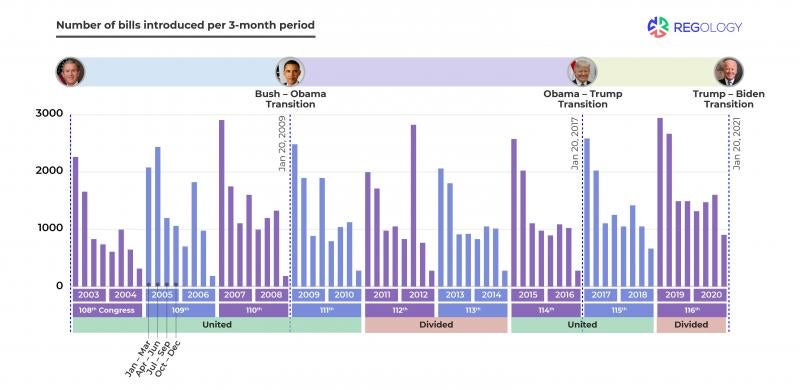
To get a sense of what can be expected now that the 117th Congress is underway and controlled by a single party, Regology performed an analysis of the legislative activity of the past 9 terms of Congress.  Regology found that the beginning of a new Congress is marked by the introduction of a large number of bills.  Although a small percentage of bills make it to law, having both houses of Congress controlled by a single party point to a significant increase in the success rate of bills being enacted.

Lawmaking by Congress: Top Three Trends

Regology identified three key trends in lawmaking activity of each Congressional term. For its analysis, Regology reviewed the bills that were introduced during the last 9 Congressional terms by both the Senate and House of Representatives, covering 18 years of lawmaking activity that led to a total of 95,000 bills reviewed.  For the 9 Congressional terms reviewed, there were 6 terms where Congress was controlled by a single party and 3 terms where there was a divided Congress.

Trend 1– 23% of all Congressional bills were introduced during the first 1/8th of the Congressional term

On average, 23% of the total amount of bills that got introduced by a Congress were introduced during the first 3 months of a Congress’ 24-month term.  The large number of bills that are expected to come through in the next couple of months will not only create plenty of work for the members of Congress and their staff, law practitioners are also challenged to assess those bills that have a chance of being enacted and determine their implications on stakeholders.

Regology Chart 1

Click to view larger.

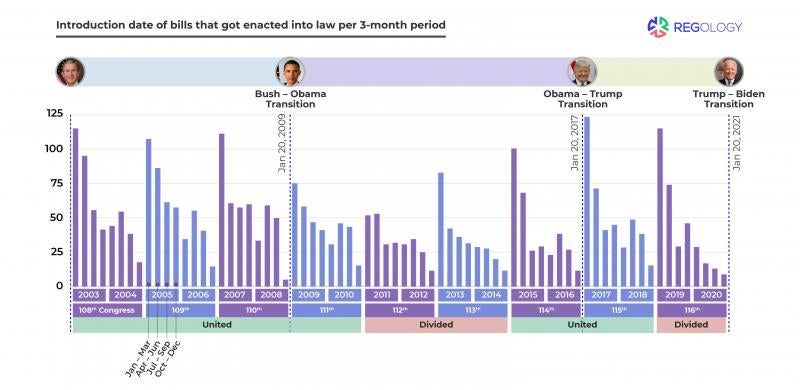
Trend 2 – 26% of a Congress’ successful bills were introduced during its first 3 months

With a success rate of approximately only 3.5%, meaning the percentage of bills that got signed into law, a lot of work is of short relevance.  Although this success rate may draw skepticism to pay close attention to the wave of bills the 117th Congress is introducing in its first 3 months, it is worth noting that Regology found that about 26% of the laws from the past 9 Congressional terms were introduced as bills in the first 3 months of the term.

Regology Chart 2

Click to view larger.

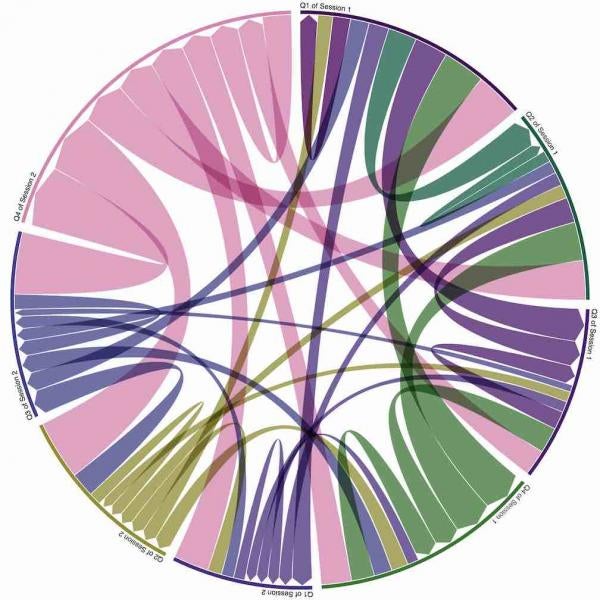
While on average it took 235 days for a successful bill to go from introduction to enactment, successful bills introduced during the first 3 months of Congress took 300+ days before they got enacted.  A visualization of the relationship between the introduction and enactment date of successful bills is shown next.

Regology Chart 3

Click to view larger.

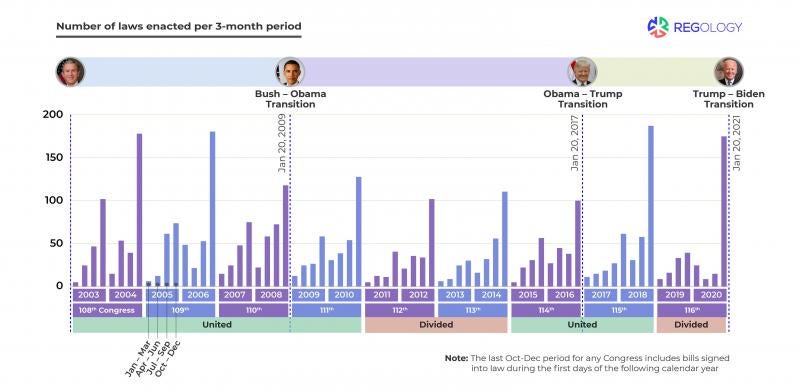
Trend 3 – 38% of a Congress’ successful bills were enacted during its last 3 months

On average 38% of all bills that became law were enacted during the last 3 months of a Congress.

Regology Chart 4

Click to view larger.

Looking back: comparing the 116th Congress to the prior 8 Congressional terms

As we look at the lawmaking activity of the 116th Congress and compare it with the lawmaking activity of the prior 8 timers of Congress, the following observations can be made:

  • The 116th Congress was very active in introducing bills.  Some 14,000 bills were introduced compared to roughly 10,000 bills averaged by the prior 8 sessions of Congress.
  • The 116th Congress managed to get 333 bills signed into law versus an average of 379 laws by the 8 prior sessions of Congress.
  • The success rate of bills that got signed into law for the 116th Congress stands at 2.3% versus 3.7% during the prior 8 terms. It must be noted that the 116th Congress was divided.

Lawmaking in a divided Congress

Single party control of both chambers of Congress has relevance in the number of bills they are able to pass into law. Such a Congress saw an average success rate of 4% while a divided Congress saw a success rate of 2.7%. Further analysis of the single party controlled Congressional terms revealed that the success rate was 3.7% for the 2 terms Congress was controlled by the Democratic Party and 4.2% for the 4 times the Republican Party controlled Congress. Nevertheless, the last 2 terms of Congress controlled by the Republican Party saw an average success rate of 3.4%.

Expectations for the 117th Congress

Looking at what to expect from the 117th Congress’ lawmaking activity, historical data suggests that we will see a significant number of bills being introduced on the floor in the first quarter of 2021. Furthermore, with a single party controlling both houses of Congress, these bills will have an almost 50% higher chance of making it into law.


© 2021 Regology All Rights Reserved
ARTICLE BY Paul V. Bruin of Regology
For more, visit the NLR Election Law / Legislative News section.

Law Firm News and Updates for January 2021: Law Firm Merger, Diversity in Legal Industry and Law School News

We hope that your 2021 is going along well all things considered.  We wanted to extend a big thank you to our law firm publishing partners for helping the National Law Review surpass 25,000,000 page views in 2020.  You can read about some of the articles and authors we noted as exceptional high flyers in our press release from earlier this week.  Additionally, we recognized roughly 70 exceptional authors and contributors in our 2020 Go To Thought Leadership Awards issued a few weeks back which you can read about here. But enough about us and our talented authors, here are some recent updates from around the legal industry.

Law Firm Hires and Promotions

Ballard Spahr named Damon O. Barry the Office Managing Partner for the Denver office of the firm. Mr. Barry is an experienced deal and government affairs attorney, working on mergers and acquisitions, recapitalizations and other sophisticated commercial transactions.  The Denver office of Ballard Spahr is the epicenter of the firm’s western United States Labor and Employment, Public Finance Data Privacy and Cybersecurity practices.  Mr. Barry praised the Denver office of Ballard Spahr, pointing out the attorneys located there do exciting work with industry leaders in the region, and said, “I’m looking forward to building on our previous success and continuing to deliver first-rate service to our clients, both existing and new, while simultaneously driving and increasing our commitment to the Denver community.”

Idan Netser and Andrew Harper joined Sidley Austin LLP in the Palo Alto office.  Both attorneys will join Sidley as transactional partners, joining the Emerging Companies and Venture Capital practice, and Mr. Netser will also join the Tax Practice.  Martin Wellington, Managing Partner of the Palo Alto office describes the addition of Mr. Nester and Mr. Harper as an important milestone in Sidley’s expansion into Northern California, and the emerging technology field of practice.  Wellington says, “Idan has a well-deserved reputation both as a trusted adviser to entrepreneurs and emerging companies in the software, security, and life sciences markets, and as a leading international tax counselor for some of the technology sector’s best-known brands. Andrew is a rising star with established relationships at an exciting roster of both companies and blue-chip venture investors. Together, they elevate our brand in the Valley and position Sidley for sustained growth in this market.”

Vedder Price announced that Wayne M. Aaron has joined the firm as a member of the Investment Services Group and Corporate practice in New York.  Mr. Aaron is an experienced securities regulatory lawyer, and his practice includes financial services advisory matters, broker-dealer regulation and enforcement, government and regulatory investigations and FinTech.  He regularly advises securities firms on complex sales and trading, and other regulatory issues, as well as in examinations, inquiries and enforcement proceedings before the Securities and Exchange Commission and other government regulators.  Corporate Practice Area Chair at Vedder, Jennifer Durham King indicated she is looking forward to Aaron’s addition to the financial services and corporate-related practices in New York.  She says, “Wayne is a terrific addition to our existing broker-dealer and regulatory investigations practices as we look to continue to grow and diversify those practices, including into other complementary areas, such as high frequency trading and FinTech regulatory work.”

Murray Plumb & Murray is pleased to announce that Katherine Krakowka has been elected a Director of the firm as of January 1, 2021, and  Stacey Neumann has been named to Murray Plumb & Murray’s Management Committee.

Ms. Krakowka has been with Murray, Plumb & Murray since 2019, focusing on Business & Corporate Law and Business Reorganization & Insolvency, and she has been working with local businesses, navigating the COVID-19 pandemic.  Drew Anderson, Managing Director of Murry Plumb & Murray calls Katie a wonderful addition to the ranks, saying,  “She has been an active participant in the firm since joining our team and this year especially has played a crucial role in supporting our local business community as a thought leader on risk planning and a legal expert on pandemic assistance programs. We look forward to having the benefit of her wisdom, experience and intellect in this leadership role.”

Additionally, Stacey Neumann has been named to Murray Plumb & Murray’s Management Committee. Neumann is a Director at the firm and Chair of the Employment and Criminal/White Collar Defense Practice Groups, and she has extensive litigation experience with federal and state white-collar and other criminal defense, employment law with discrimination and other human resources matters, and Title IX investigations and other collegiate disciplinary processes.

Steven W. Zelkowitz joined Spiritus Law as Managing Partner, reuniting with Spiritus law founding partners Marbet and Robert Lewis.  Additionally, Jonathan Portuondo is joining Spiritus Law as an associate. Spiritus Law will be focusing on helping firm hospitality clients recover from the pandemic.

Mr. Zelkowitz comes to Spiritus Law with more than 30 years of experience in real estate, financial services industries, including infrastructure and development, hospitality and public/private partnerships.  Zelkowitz also has government relations experience, and experience in assisting businesses establishing or relocating to Florida by leveraging tax and other financial incentives.  Additionally, Zelkowitz has a long-established relationship with the firm’s founders Robert and Marbet Lewis, which will translate into a productive and effective working relationship.

“Spiritus Law is already known as a powerhouse nationally in the alcohol and hospitality industries. I am confident that my depth of experience will further cement the firm’s reputation in those industries in 2021 and beyond,” said Mr. Zelkowitz. “I am both humbled and excited to reunite with Marbet and Rob, and in applying my decades of experience growing law firms for the benefit of Spiritus Law and its clients at this pivotal moment in history.”

Dinsmore & Shohl Merges with Wooden McLaughlin

On January 1, 2021, Dinsmore & Shohl LLP has merged with Wooden McLaughlin LLP in Indiana, continuing Dinsmore’s growth across Indiana, adding offices in Indianapolis, Evansville and Bloomington.  Dinsmore added 47 Wooden attorneys, growing Dinsmore’s lawyer headcount by over 7 percent, and continuing Dinsmore’s goal of continued growth and strength in the Midwest.  George Vincent, Dinsmore Chairman and Managing Partner, says, “I’ve always believed in having a renewable five-year plan and working back from where you want to be. Five years ago, we wanted to be in Boston, Florida and Indiana, and we’ve done all of those things. We are in every state surrounding Indiana, so it is a natural place for us to be. There are significant opportunities for new and existing Dinsmore clients there, and Wooden has a great legacy.”

The merger builds on both firm’s legacies of valued client relationships that can span decades, with an emphasis and value on diversity.  Wooden Partner, Misha Rabinowitch, says Dinsmore’s focus on diversity was an important element in the decision, saying, “I’m personally excited to continue working to make our offices as inclusive as possible, now with the assistance of Dinsmore’s diversity initiatives that are already in place and have great momentum.”

Law Firm Diversity: Norton Rose Fulbright and Blank Rome Tap New Diversity and Inclusion Officers, and Nelson Mullin’s Diversity Pipeline Outreach Program Recognized

Norton Rose Fulbright announced that Katherine Tapley, a San Antonio partner, will replace Denise Glass as the firm’s new US Chief of Diversity and Inclusion.  She will chair the US Diversity and Inclusion Committee at the firm, and she will work closely with the US Management Committee to strengthen Norton Rose Fulbright’s diversity and inclusion efforts.  Tapley previously chaired the Women in Norton Rose Fulbright (WiN) Network.  Additionally, Tapley has served on the Real Estate Service Board of Directors for the San Antonio Area Foundation, and she currently chairs the Board of Governors of SA Youth, a non-profit working to improve the education, character and lives of high-risk San Antonio youth.

Jeff Cody, Norton Rose Fulbright’s US Managing Partner: “Katherine championed diversity for several years at Norton Rose Fulbright, consistently looking for opportunities for the firm to make meaningful enhancements. While we have made notable progress in our diversity and inclusion efforts, this important area remains a priority for us.”

Norton Rose Fulbright achieved several honors related to their diversity efforts, including a Gold Standard Certification by Women in Law Empowerment Forum (WILEF) for their inclusion of women into leadership positions.  Norton Rose Fulbright also received a perfect score from the Human Rights Campaign Foundation on its Corporate Equality Index for policies related to LGBT workplace equality, and Diversity Lab announced Norton Rose Fulbright had achieved Mansfield Rule Certification 3.0 and Mansfield Certification Plus status, both benchmarks in the legal industry.

Ms. Tapley announced a desire to continue the firm’s work in this important area, saying, “Fostering diversity and inclusion is a critical component to being the best possible place to work for our people. I will work tirelessly to ensure the firm succeeds in this arena.”

Nelson Mullins Diverse Pipeline Outreach Program was selected by Profiles in Diversity Journal as a winner in its Top 10 Innovations in Diversity for 2020.  The Innovations in Diversity honors inventive solutions in workforce diversity, selecting corporations, organizations, and institutions for ground-breaking programs furthering inclusion and diversity in their respective fields.

The goal of Nelson Mullins Diverse Pipeline Outreach Program is to combat a lack of diversity in the legal industry by working with Historically Black Colleges and Universities in the Carolinas and Georgia to provide students with an inside look at the legal profession.  By demonstrating the legal industry in action across a variety of areas and demystifying the steps to go to law school and become a practicing attorney and capping it off with a paid internship for one student at each school that participates. The first internship will begin in the spring of 2021.

The Nelson Mullins program is spearheaded by Ariel Roberson and Jack Slosson, partners in Raleigh and Charlotte, respectively.  Roberson says, “Diversity in the legal profession is tremendously lacking, but we all know how necessary it is to hear different perspectives in the courtrooms, boardrooms, classrooms, etc. across America.”   Slosson says, “I am hopeful that this unique program can have a real impact in growing diversity in the legal profession going forward.”

Blank Rome announced that Krystal Studavent Ramsey is the firm’s new Director of Diversity and Inclusion in Blank Rome’s Houston office.  As Director of Diversity and Inclusion, Ms. Studavent Ramsey will implement Blank Rome’s strategic DEI plans to create an inclusive environment within the firm, and to partner with clients on DEI plans and programs.  To further this goal, Studavent Ramsey brings her experience co-founding and co-chairing Blaxiom, a group of Black Axiom employees when she served as a senior legal consultant at Axiom, and her experience working as director of strategy and operations for the Diverse Attorney Pipeline Program, devoted to nurturing first-year, women of color law students.

Studavent Ramsey calls her new role “an amazing opportunity” and praises Blank Rome’s foundation of DEI.  She says, “I am excited to join Blank Rome as its Director of Diversity and Inclusion, especially at such a pivotal time in our world . . . [T]his is an amazing opportunity . . . to make sustainable change and a positive impact throughout our firm, the legal industry, the communities we serve, and beyond.”

Law School Updates

Over 150 academics issued a joint statement saying “The violent attack on the Capitol was an assault on our democracy and the rule of law. The effort to disrupt the certification of a free and fair election was a betrayal of the core values that undergird our Constitution. Lives were lost, the seat of our democracy was desecrated, and our country was shamed.”

Citing their role as the educators of the next generation of lawyers, the academics claimed an obligation to “support the rule of law and preserve the integrity of the legal profession.”  The statement frowned on the actions of attorneys filing frivolous and ungrounded lawsuits challenging the election, filings unsupported by any evidence, saying they “betrayed the values of our profession” by doing so.  Additionally, the statement praised the lawyers and judges who worked hard to bring about an honest election in trying circumstances.  Read the complete joint statement and see a list of academics who signed the Joint Statement on the 2020 Election and Events at the Capitol.

John F. Kennedy School of Law at Northcentral University welcomed its first cohort of law students in the online Juris Doctor program, the university announced last week.  Since 1996, Northcentral University has been a leader in graduate-focused online education, with over 11,000 students enrolled in graduate programs across education, psychology and now law.

The program is taught by faculty who are practicing attorneys, judges and other legal professionals, to bring real-world expertise into the virtual classroom.  Faculty areas of expertise include civil and criminal law, constitutional law, insurance defense litigation and public interest law.  Along with online classes, hands-on curriculum opportunities include clinical and internship experiences. Dean Hutton says the online JD program will have opportunities for students to get individualized feedback from faculty members.  He says, “”Students have multiple opportunities to apply legal doctrine throughout each course, along with personalized faculty feedback, allowing for a much deeper understanding of the material and greater preparation for exams and, ultimately, for the California Bar Examination.”

Other law offerings at Northcentral include a Bachelor of Arts in legal studies and a paralegal certificate program, both approved by the American Bar Association.

Copyright ©2020 National Law Forum, LLC


For more, visit the NLR Law Office Management section.

International Air Travelers Entering the United States Must Have a Negative COVID-19 Test

Effective Jan. 26, 2021, all air passengers traveling to the United States will be required to get a viral test for current infection within the three days before their flight to the U.S. is scheduled to depart, and provide written documentation of their laboratory test results (paper or electronic copy) to the airline. In lieu of a negative test result in that timeframe, the passenger may provide documentation of having recovered from COVID-19 in the past three months and proof of having been cleared for travel by a licensed health care provider or health official.

How Will This Rule Be Enforced?

Airlines will be required to confirm the negative test result for all passengers (or documentation of recovery from COVID-19) before they board. Therefore, if a passenger cannot provide documentation of a negative test or recovery, or chooses not to take a test, the airline is required to deny boarding to the passenger.

A negative test result must be provided to the airline in order to return by air travel to the United States. All travelers must plan to allow for testing and receipt of laboratory test results when planning return travel to the United States.

Travelers may also be required to produce written documentation (either paper or electronic copy) of their test results upon request to any U.S. government official or a cooperating state or local public health authority.

Who Does the Testing Requirement Pertain To?

The testing requirement applies to all air travelers bound for the U.S., including U.S. citizens and is required for all airline passengers ages two and older. Even those individuals who already have received the COVID-19 vaccine must provide evidence of a negative COVID-19 test for travel.

NOTE: The rule does not apply to passengers on flights from the U.S. Virgin Islands and Puerto Rico, since those are U.S. territories.

Which Type of Test Do I Need?

Passengers will need to provide results from an antigen test or PCR (viral antigen or nucleic acid

amplification test). Antibody test results will not be accepted, because the test results must rule out current COVID-19 infection.

For those individuals who have recovered from COVID-19, they can provide documentation of having recovered from COVID-19 in the past three months (they can bring evidence of their previous positive test result, with proof that they have been cleared for travel by a licensed health care provider or health official).

Where Can I Get Tested in a Foreign Country?

Look for guidance from airlines, hotels, tourism bureaus and health care providers when booking travel.  Many countries post their current COVID-19 protocols and guidance for international travelers needing to be tested, as well.

How Long Will This Rule Be In Effect?

The rule is in place indefinitely, and likely will remain in place until the coronavirus surge has subsided or other controls are in place.

Additional CDC Recommendations

As always, the CDC also continues to advise travelers to also get tested again three to five days after arrival in the U.S. and to stay at home for seven days post-travel to help slow the spread of COVID-19 within U.S. communities.


© 2020 Dinsmore & Shohl LLP. All rights reserved.
For more, visit the National Law Review Coronavirus News section.

EEOC Says Employers May Mandate COVID-19 Vaccinations – Subject to Limitations

With one pharmaceutical company already receiving emergency use authorization for its COVID-19 vaccine, and a second drug maker apparently on the cusp of receiving authorization, employers, eager to return to normal business operations, are considering whether they can require that their employees be vaccinated.  In analyzing this issue, employers are looking to the Equal Employment Opportunity Commission (EEOC) for direction on their ability to require vaccinations, given the legal protections under the Americans with Disabilities Act (ADA) and other federal employment laws.

On Wednesday, December 16, 2020, the EEOC delivered welcome news in the form of a revised pandemic guidance concluding that employers generally can mandate that employees receive a U.S. Food and Drug Administration (FDA)-authorized or approved COVID-19 vaccine.

That EEOC guidance, however, includes a variety of cautionary instructions for employers, including for example, potential restrictions on disability-related questions and recognized protections that must be afforded to employees seeking exemption from vaccination requirements due to medical conditions or sincerely held religious beliefs.

The following summary of the guidance provides some helpful information for employers on this complex topic:

  1. Can an employer require that employees receive one of the new FDA-authorized COVID-19 vaccinations?

ANSWER: Generally, yes.  The EEOC stated that equal employment opportunity laws “do not interfere with or prevent employers from following CDC or other federal, state, and local public health authorities’ guidance and suggestions.”  However, there are potential complications that employers must consider before implementing a mandatory vaccination program.

The EEOC confirmed that vaccination itself is not a medical examination, but it also pointed out that certain medical-related questions need to be posed to an individual before the vaccine is given to assure that the person does not have a medical condition that makes the vaccine unsafe. The EEOC explains that those questions can constitute “disability-related inquiries” regulated by the ADA, which employers may only ask under certain circumstances.

Notably, the EEOC indicates that the limitations on asking those disability-related inquiries do not exist when the vaccine is given (and the questions posed) by a third party that is not controlled by the employer such as a pharmacy or healthcare provider rather than by the employer directly or by a healthcare provider working under contract for the employer.  It also explained that it is permissible for an employer to offer the vaccination to employees on a voluntary basis, provided that the employee’s decision to answer pre-screening, disability-related questions is entirely voluntary.

Certainly, the most significant limitation on a mandatory program is that the employer has to ensure that it properly considers requested exemptions by an employee from the vaccination requirement because of the worker’s (i) sincerely held religious beliefs protected under Title VII or (ii) medical conditions which make receipt of the vaccine dangerous or otherwise inappropriate for that individual consistent with the reasonable accommodation requirements of the ADA.

  1. Can an employer ask an employee if he or she has already received the vaccine or, similarly, require proof that the employee has been vaccinated?

ANSWER:  Generally, yes. The EEOC guidance explains that these particular questions do not constitute a “disability-related inquiry” because an employee may choose not to have the vaccine for a variety of reasons wholly unrelated to any medical condition.  However, an employer has to meet certain requirements if it wants to find out why an employee has not received the vaccine. Questioning the employee about the reasons that individual has not been vaccinated does constitute a “disability-related inquiry” because of the possibility that it will elicit information about a disability.

That inquiry can only be made, according to the EEOC, if the question is “job-related and consistent with business necessity” as provided under the ADA. To meet this job-relatedness standard, the employer will need to establish that the worker’s failure to be vaccinated would pose a “direct threat” to the well-being of that employee or others with whom the employee would have contact as part of his or her job duties. Language elsewhere in the EEOC pandemic guidance suggests that an employer should be able to establish that “direct threat” standard if the employee has significant contact with other workers or third parties as part of performing his or her job duties.

  1. Can an employer have its own medical staff or a contracted healthcare provider conduct the vaccinations?

ANSWER:  Generally, yes. The EEOC guidance does not suggest an employer is barred from having its own in-house vaccination program or contracting directly with an outside healthcare provider to administer the vaccinations to the company’s employees. However, as indicated above, the EEOC does indicate that there are potential limitations on the employer either directly, or through a contracted service provider, asking pre-vaccination medical questions.  For that reason, some employers may mandate the vaccine but not administer it directly to employees.

  1. Can an employer fire an employee who refuses to be vaccinated? 

ANSWER:  Possibly, in limited circumstances.  The EEOC guidance reminds employers that it will need to make reasonable accommodations to employees seeking an exemption due to disability-related reasons or religious objections and will need to follow the established reasonable accommodation process under either the ADA or Title VII before taking any adverse employment actions.  The EEOC cautions employers that if it can establish that an employee who is not vaccinated poses a direct threat (that cannot be accommodated without an undue hardship), the employer can exclude the employee from the worksite, but the employer cannot terminate the employee without further consideration of the employee’s legal protections or other possible accommodation, including whether the employee can perform his or her job remotely.  In assessing hardship, the EEOC noted that the prevalence in the workplace of employees who already have received a COVID-19 vaccination and the amount of contact with others, whose vaccination status could be unknown, may impact the undue hardship consideration.

  1. Does the EEOC guidance mean that all employers should adopt a mandatory vaccination program?

ANSWER:  Not necessarily; a mandatory vaccination program may not be the best choice for many employers.  First, any such program would require that employers implement appropriate procedures with respect to processing of disability and religious accommodation requests.  Any employer with a mandatory vaccine program must ensure that there is no retaliation against employees who request an accommodation under the ADA or Title VII.  There may also be retaliation protection under Section 11(c) of the Occupational Safety and Health Act of 1970 pertaining to whistle blower rights for an employee who refuses vaccination because of a reasonable belief that he or she has a medical condition that creates a real danger of serious illness or death (such as serious reaction to the vaccine).

Further, polling data continues to show that a significant percentage of Americans prefer not to receive the COVID-19 vaccine.  Some employees, for example, may be wary of the vaccine given how rapidly it was developed.  As a way of recognizing this issue, the EEOC guidance points out that the FDA authorization for these COVID-19 vaccines is only pursuant to the Emergency Use Authorization standard—which is different than an FDA approval (licensure) of a vaccine—and therefore these vaccines have not received all of the prolonged consideration by the FDA that is typical of common vaccinations such as the vaccines for seasonal influenza or chickenpox.

As a result, employers mandating the vaccine should be prepared for some resistance from employees.  Additionally, it is important to remember that the EEOC guidance is only that—guidance—and not a law. Consequently, some employees may still legally challenge mandatory vaccination programs under various theories and there is no guarantee that a court will react favorably to a particular legal challenge. There are also, as explained above, important legal nuances and limitations with a mandatory program even under the EEOC’s guidance.

Also, while not an EEO issue, for employers with a unionized workforce, the employer must consider bargaining requirements prior to unilaterally implementing a mandatory vaccine policy.  Additionally, employers may need to consider state law obstacles to mandatory vaccination in some jurisdictions.

What is clear is that if an employer wants to pursue a mandatory vaccination program, the company’s management, together with its legal and HR teams, should engage in significant planning and develop a program detailing how the process will work from beginning to end and carefully consider the potential legal limitations identified by the EEOC in its guidance.


© 2020 Bracewell LLP

For more, visit the NLR Coronavirus News section.

Shining a Spotlight on ESG Disclosures in the Biden Administration

In a period where almost nothing seems certain, it is inevitable that ESG issues will be on the front of the incoming SEC Chair’s mind. Jay Clayton, who resigned as SEC Chairman in December 2020, has urged that one-size-fits-all metrics for environmental disclosures aren’t appropriate given the varied impacts of climate change on different industries. However, President-elect Biden has made clear that climate change will be a high priority for his administration: he has vowed to rejoin the Paris Climate Agreement on his first day of office. Thus, the five-member SEC, where three seats are controlled by the President’s party, can be expected to make ESG disclosures a high priority.

Investors are also in part to thank (or blame) for the growing significance of ESG topics in public disclosures. An SEC advisory committee that advocates for investors urged last May that the SEC establish disclosure policies regarding ESG topics, arguing that investors want reliable information on these matters before making investment and voting decisions. And in its 2019 “Statement on the Purpose of a Corporation,” even the Business Roundtable—a former champion of “shareholder primacy”—agreed that the purpose of corporations is to promote “an economy that serves all Americans.” While this document has been criticized for not providing more palpable sustainability goals, Rep. Joe Kennedy (D-Mass.) called it “a welcome step toward a more moral capitalism” and the U.S. Chamber of Commerce said it “agreed wholeheartedly with the renewed focus.” With the changing of the guard at the SEC, all signs point in the direction of further steps toward “moral capitalism” in the months to come.


© 2020 Proskauer Rose LLP.

For more, visit the NLR Securities & SEC section.

Can U.K. Employers Make COVID-19 Vaccinations Mandatory?

So, can employers mandate that their workforce receive the vaccine? Employers have a legal duty to ensure the health and safety of their workforce as far as reasonably possible, so such a requirement would appear to be an effective means of satisfying this duty. However, whilst there may be certain settings where such a requirement is reasonable — for example, in health care or other high-risk areas — employers should be very cautious about pursuing a policy of mandatory vaccination since this could have a number of legal implications.

Primarily, such a policy could expose an employer to claims, including for discrimination and/or constructive dismissal if an employer were to take detrimental or disciplinary action because an employee refuses to be vaccinated and such refusal is related to a characteristic that is protected under U.K. discrimination law (namely, age, disability, gender reassignment, marriage and civil partnership, pregnancy and maternity, race, religion or belief, sex or sexual orientation). For example, there is a risk of maternity or disability discrimination where employees who are pregnant or suffering from a medical condition that amounts to a disability are not able to have the vaccine and are consequently treated less favourably by their employer than employees who have had the vaccine. Likewise, such a requirement could also amount to age discrimination if younger employees, who are likely to be the last category of people being offered the vaccine as part of the NHS rollout, are treated less favourably than older employees who have had the vaccine.

A policy of mandatory vaccination could also infringe employees’ right to privacy under Article 8 of the Human Rights Act 1998. Technically an employer may be able to justify such a breach, but this is likely to be difficult where less personally invasive measures are available to employers to maintain the health and safety of their workforce, such as social distancing and the wearing of face coverings.

Employers should also consider the data protection implications of mandating vaccinations since holding data on whether an employee has had the vaccine is likely to be considered a special category of data under applicable data protection law (meaning that it needs more protection because it is sensitive). In order to lawfully process such data, there must be a lawful basis for the processing, and additional conditions and supporting documentation must be put in place, including conducting an impact assessment to identify and minimise any risks.

Whilst a policy of mandatory vaccination may present difficulties from a legal perspective, employers may want to put in place nonmandatory guidance about the vaccine to encourage their employees to have it. Additionally, employers should not rely on vaccination to replace other protective measures in the workplace, such as social distancing and the wearing of face coverings, and should continue to assess their workplace risks as the pandemic unfolds.


© 2020 Faegre Drinker Biddle & Reath LLP. All Rights Reserved.

For more, visit the NLR Labor & Employment section.